
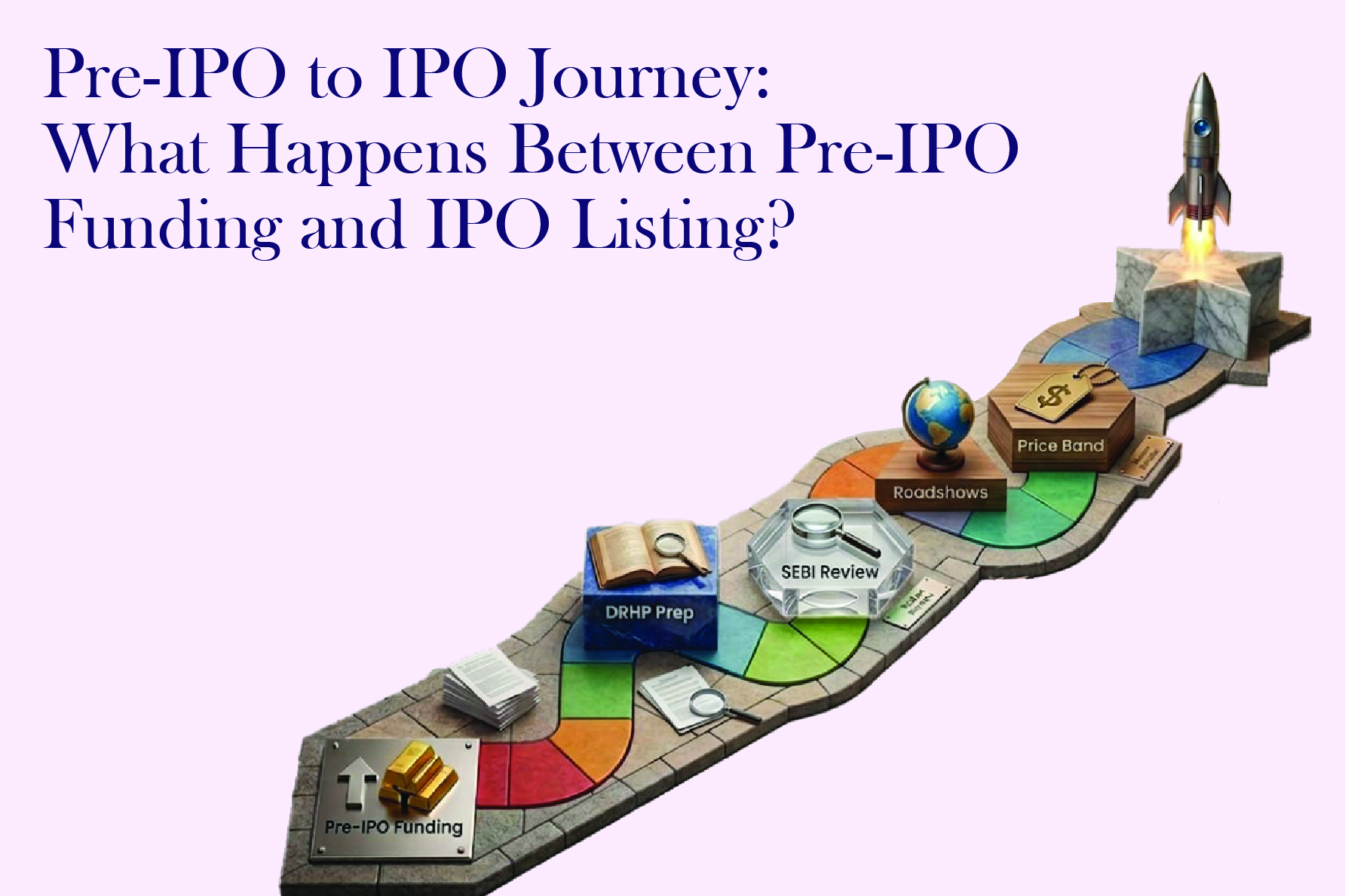
Investors often hear that “real wealth is created before IPO.”
But why? What exactly happens between Pre-IPO funding and the IPO listing that unlocks such significant value?
And how can retail and HNI investors strategically position themselves to capture this value?
This blog goes deep into the mechanics, valuation shifts, institutional behaviour, and investor psychology that shape the journey from Pre-IPO to IPO giving you a professional, research-based understanding typically reserved for insiders.
Valuation discovery begins
Institutional capital enters early
Governance improves
Financial metrics get sharper
Market visibility increases
Every stage from Pre-IPO → IPO creates progressive value unlocking, which is why investors entering early often outperform IPO investors by a significant margin.
After a company raises Pre-IPO capital, the real transformation begins.
This phase brings the sharpest valuation jump, often 20-50% even before filing DRHP.
Institutional investors (VC/PE/HNI/Family offices) enter here because:
It is the last chance to buy at private-market valuations
Risk reduces as IPO becomes visible
Governance improves before SEBI scrutiny
Financial trajectory (YoY growth, margins)
Use of Pre-IPO funds
Corporate governance track record
Sector tailwinds and premium trends
Competitive moats
Supremus Angel helps investors shortlist companies with strong fundamentals and Pre-IPO readiness.
Once bankers enterl, the IPO process becomes structured.
Transparent disclosures begin
Valuation expectations become clearer
Media and analysts start tracking the company
Demand for unlisted shares increases as more data becomes public
This is a sweet spot where early Pre-IPO investors can still enter before the market re-rates the company.
Industry benchmarks
Expected IPO size
Red flags in risk sections
Existing investor exits (PE/VC selling?)
Fresh issue vs OFS (critical for long-term returns)
Accuracy of disclosures
Corporate governance
Financial compliance
Legal transparency
Risk reduces significantly.
As risk drops → valuation goes up.
This stage often increases unlisted share prices by 10-25% due to higher investor confidence.
Mutual fund houses
Global institutional investors
Domestic analysts
HNI syndicates
This stage is technically the final value discovery round before the IPO, driven by:
Institutional feedback
Growth projections
Competitive benchmarking
Investor appetite
A strong roadshow almost guarantees:
Heavy oversubscription
Grey market activity
Strong listing performance
This is usually the last chance for strategic investors to accumulate Pre-IPO shares.
By now, the valuation has moved from:
Private Market Value → Pre-IPO Value → Expected IPO Value
Key Insight: IPO price band is rarely “cheap.”
It reflects:
Market momentum
Sector valuation
Demand from institutional investors
Pre-IPO investors usually hold shares at 20-40% lower buying cost compared to IPO price band giving them a built-in buffer.
IPO opens → subscriptions decide listing sentiment → institutional bids determine stability → final listing decides exit valuations.
If listing premium is strong → book partial gains
If long-term story is strong → hold 60-70% for compounding
Avoid emotional exits focus on fundamentals, not noise
Examples have shown Pre-IPO investors outperformed IPO investors in companies like: Nykaa, Zomato, DMart, Tata Technologies, LG.
Between Pre-IPO Funding and DRHP Filing
Why? Because:
Risk is manageable
Valuations are more attractive
Growth visibility becomes clear
Governance improves
Competition is low
After DRHP but before SEBI approval
Because valuation uplift starts here.
Post-DRHP → Roadshow Phase
Demand peaks here but valuations may not offer deep upside.
Supremus Angel provides:
Research-driven company screening
Access to growth companies not yet listed
Transparent pricing in the unlisted market
Entry points with optimized risk-reward ratio
Dedicated insights for retail, HNI & UHNI investors
This positions investors to make data-backed, early-stage, high valuation arbitrage decisions.
Each phase funding, DRHP, SEBI review, price discovery, listing reduces risk and increases valuation, which is why entering early can generate superior returns.
For investors, the key is:
Understand the journey
Read valuation signals
Enter at the right stage
