
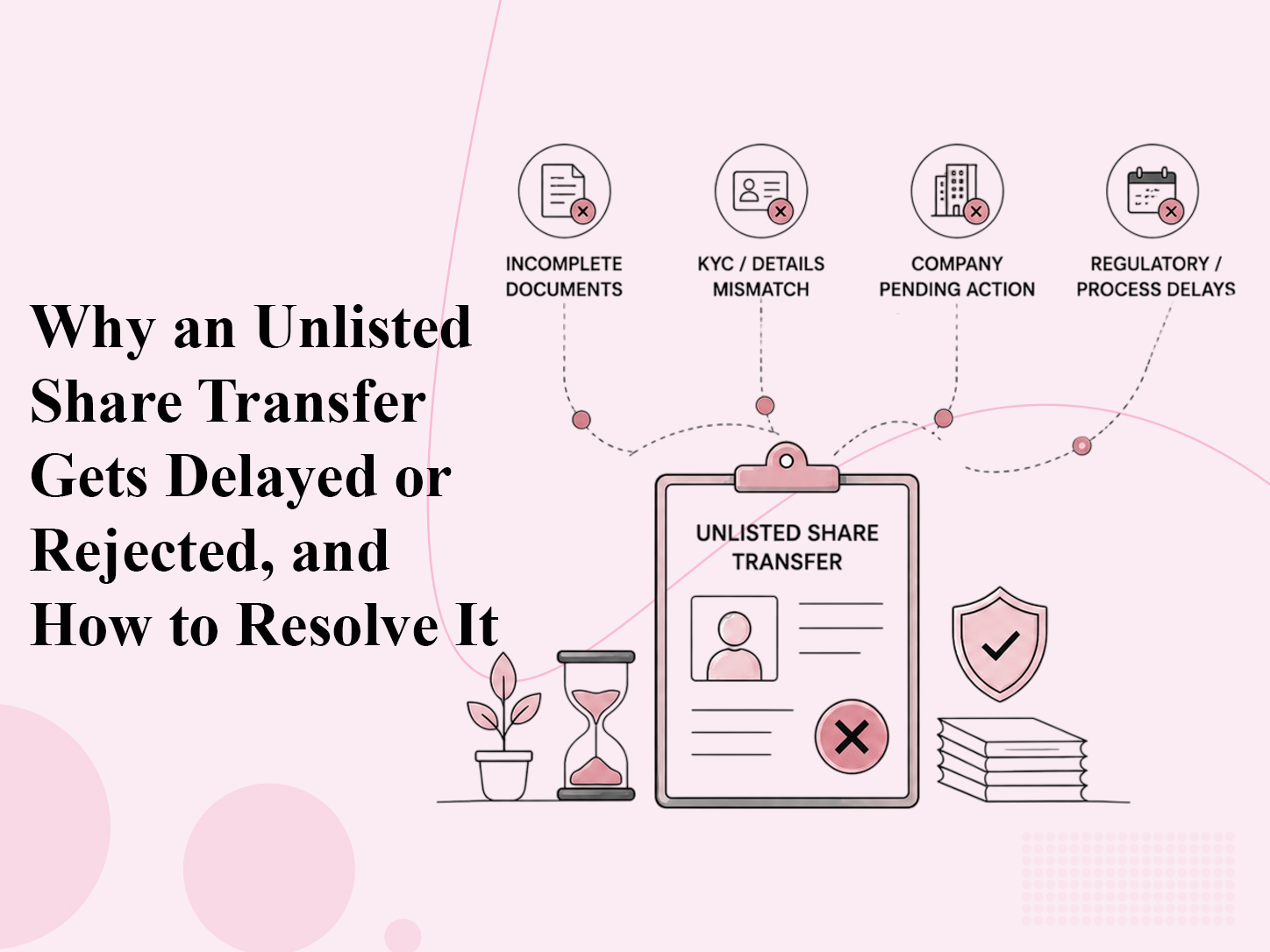
An unlisted share transfer gets rejected when the paperwork, ownership details, or company-side approvals don't line up with what the registrar or the company's board requires. Unlike listed shares, which move instantly through a stock exchange, transferring unlisted shares depends on manual verification, company consent in some cases, and correct documentation at every step. Understanding where the process typically breaks down helps investors avoid delays and resolve issues faster when they occur.
An unlisted share transfer is the process of moving ownership of shares in a company that isn't listed on a stock exchange from a seller's demat account to a buyer's demat account. Because there's no exchange matching buyers and sellers automatically, the transfer relies on a physical or digital delivery instruction, verification by the depository participant, and in some cases, approval from the company itself.
This is fundamentally different from a listed share transaction, where settlement happens within a fixed cycle through the exchange's clearing system. With unlisted shares, timelines vary, and a transfer can stall at more than one point along the way.
A delayed or rejected transfer isn't just an administrative inconvenience. It can hold up settlement of a transaction that both buyer and seller have already agreed to commercially, create uncertainty around who legally holds the shares in the interim, and in some cases affect an investor's ability to participate in a corporate action that has a record date attached to it.
Because unlisted transactions are typically negotiated privately, there's also no exchange-level mechanism to fall back on if something goes wrong. The responsibility for getting documentation right, confirming company-level requirements, and following up with the relevant parties sits largely with the investor and their depository participant. Understanding why an unlisted share transfer rejected outcome occurs, and how to work through it, reduces the chances of a transaction stalling indefinitely.
Transfers get rejected more frequently in the unlisted space than in listed markets, mainly because there's less standardisation. Every company can set its own conditions around share transfers, especially if its Articles of Association include restrictions like a right of first refusal or board approval requirements.
An unlisted share transfer rejected notice usually isn't random. It traces back to a specific mismatch in signatures, folio details, KYC records, or company-level restrictions that a human or automated check catches before the transfer completes. Recognising the common causes makes it easier to prevent them, and in most cases, easier to resolve them within a reasonable timeframe as well.
A large share of rejections trace back to documentation. This includes mismatched PAN details, outdated KYC records, incorrect client master details, or a signature on the delivery instruction slip that doesn't match bank or demat records. Even small inconsistencies, like a name spelled differently across documents, can trigger a rejection.
These mismatches often go unnoticed until the transfer is actually attempted, since KYC records can drift out of date over time; an address change, a bank account update, or a name change after marriage are common examples that investors don't always think to update across every linked record.
Errors in the delivery instruction slip (DIS) , a wrong ISIN, incorrect quantity, or missing signatures are among the most common technical reasons a transfer doesn't go through. Depository participants generally won't process a transfer with incomplete instructions.
Because the DIS is a manual document in most cases, small clerical errors are more likely than they would be in an automated, exchange-driven process. Double-checking the ISIN against the company's official records before submission is a simple step that prevents a large share of these rejections.
Some companies restrict who can hold their shares, particularly startups and closely held businesses with a defined shareholder base. Restrictions might include a right of first refusal, requiring existing shareholders to be offered the shares first, or a requirement that the board of directors approves any new shareholder.
These restrictions exist for legitimate governance reasons companies often want visibility into who holds their equity, particularly before an IPO. For investors, this means confirming the company's transfer policy before agreeing commercially to a transaction, rather than discovering the restriction after the fact.
If a company is in the middle of a rights issue, bonus issue, stock split, or any other corporate action, transfers can be paused temporarily until the action is completed and the register of members is updated.
This is typically a timing issue rather than a documentation problem, and it resolves on its own once the corporate action concludes. Checking with the company or its registrar in advance can help investors avoid submitting a transfer request at a point when it's guaranteed to be paused.
Transfers involving NRIs, foreign nationals, or entities subject to FEMA or other regulatory frameworks require additional compliance checks. A missing declaration or an incomplete regulatory filing can delay or block the transfer until it's resolved.
These holds tend to take longer to clear than domestic documentation issues, since they often involve coordination between the depository participant, the company, and sometimes an authorised dealer bank. Investors in this category should build additional time into their expectations from the outset.
Private companies may have restrictions on transfer of shares through their Articles of Association, including provisions such as rights of first refusal or requirements relating to approval. A transfer request submitted before dematerialisation is complete will not go through.
Dematerialisation itself can take time, particularly if the underlying share certificates are old or if the company's registrar needs to verify historical records before confirming the request. This is worth factoring in early, especially for shares that have been held for a long period without any prior corporate action.
When an unlisted share transfer rejected notice comes through, a structured approach helps identify and fix the issue faster than repeated resubmissions.
● Read the rejection reason carefully depository participants usually specify the exact cause
● Cross-check KYC details across PAN, demat account, and bank records for mismatches
● Verify the delivery instruction slip for correct ISIN, quantity, and signatures
● Confirm the shares are fully dematerialised before resubmitting the request
● Check the company's Articles of Association for transfer restrictions or approval requirements
● Contact the company's registrar and transfer agent (RTA) to confirm the current shareholder register status
● Resolve any pending regulatory declarations, especially for NRI or foreign investor transactions
● Reconfirm timelines with both depository participants involved in the transaction
● Resubmit the corrected transfer request and retain acknowledgement records
Each step narrows down where the mismatch originated, rather than guessing and resubmitting the same request repeatedly.
| Factor | What to Check | Good Sign | Red Flag |
| KYC details | PAN, address, bank records | Consistent across records | Mismatched or outdated details |
| Delivery instruction slip | ISIN, quantity, signature | Correctly filled and signed | Missing or incorrect fields |
| Dematerialisation status | Physical vs demat holding | Fully dematerialised | Still in physical form |
| Company restrictions | Articles of Association | No unusual restrictions | Right of first refusal or board approval clause |
| Corporate actions | Any pending issue or split | No pending action | Rights issue, bonus, or split in progress |
| Regulatory status | FEMA, NRI declarations | Compliant and complete | Missing regulatory filing |
| Registrar confirmation | RTA shareholder record | Matches transfer request | Discrepancy in shareholder register |
| Depository participant coordination | Buyer and seller DP details | Verified on both ends | Details not cross-confirmed |
| Aspect | Listed Shares | Unlisted Shares |
| Settlement | Automated via exchange clearing | Manual, depends on DP and company |
| Timeline | Fixed settlement cycle | Varies, can take days to weeks |
| Company approval | Not required | May be required depending on AOA |
| Rejection frequency | Rare, mostly technical | More common, multiple failure points |
| Documentation | Standardised | Varies by company and transaction |
This comparison isn't meant to suggest one is better than the other — it simply explains why unlisted transfers carry a higher chance of delay and need more careful preparation.
Not every rejection means the transaction itself is at risk. Most issues are procedural and resolvable within a reasonable timeframe once the specific cause is identified. Investors should proceed with resubmission once documentation is corrected and confirmed with the depository participant and, where relevant, the company's registrar.
A pause is more appropriate when the rejection stems from company-level restrictions that require board approval or right-of-first-refusal clearance, or when regulatory compliance is incomplete. In these cases, resubmitting the same request without addressing the underlying restriction usually leads to another rejection. Investors should evaluate carefully whether the underlying condition can realistically be met before committing further time to the transaction.
It also helps to separate the commercial agreement from the procedural transfer when thinking about timelines. Two parties can agree on a price and quantity in a day, while the actual transfer of ownership takes considerably longer depending on the company involved. Building this distinction into expectations from the start avoids unnecessary frustration when a transfer doesn't complete as quickly as the negotiation did.
● Resubmitting the same delivery instruction without identifying the actual rejection reason
● Assuming all companies follow the same transfer process
● Overlooking Articles of Association restrictions before agreeing to a transaction
● Not confirming dematerialisation status before initiating the transfer
● Ignoring KYC mismatches until they cause a rejection
● Failing to coordinate directly with the registrar and transfer agent
● Underestimating timelines for NRI or foreign investor transactions
● Not retaining documentation and acknowledgements from each stage of the process
Supremus Angel helps investors access information related to pre-IPO and unlisted opportunities, including details on company structure, share-related documentation, and market context that support an investor's own due diligence. This extends to helping investors understand the general process and common friction points around unlisted share transfers, so they can approach transactions with better-informed expectations.
Supremus Angel does not process transfers on behalf of investors, does not guarantee transfer timelines, and does not promise that any transaction will go through without procedural friction. Outcomes depend on company-specific requirements, depository processes, and the accuracy of documentation submitted. Investors should evaluate each transaction on its own terms and consult the relevant depository participant, registrar, or company where clarification is needed.
1.Why does an unlisted share transfer get rejected?
Common reasons include KYC mismatches, incorrect delivery instruction details, incomplete dematerialisation, company-level transfer restrictions, and pending regulatory compliance for certain investor categories.
2.How long does an unlisted share transfer usually take?
Timelines vary by company and depository participant, and can range from a few days to several weeks depending on whether company approval or additional compliance checks are required.
3.Can a company refuse to approve a share transfer?
Yes, if the company's Articles of Association include provisions like right of first refusal or board approval requirements, the company can decline or delay approval under those terms.
4.What should I do if my unlisted share transfer is rejected?
Review the specific rejection reason provided by the depository participant, correct the identified issue, and coordinate with the registrar or company where needed before resubmitting.
5.Do unlisted shares need to be dematerialised before transfer?
Yes, shares held in physical form need to be converted to demat form before they can be transferred electronically between accounts.
6.Is KYC verification different for unlisted share transfers?
The KYC requirements are similar to those for listed shares, but mismatches are more likely to surface during unlisted transfers because of additional manual verification steps.
7.Are NRI investors more likely to face transfer delays?
NRI and foreign investor transactions often involve additional regulatory declarations under frameworks like FEMA, which can extend timelines if documentation is incomplete.
8.What is the role of the registrar and transfer agent in an unlisted share transfer?
The registrar and transfer agent maintains the company's official shareholder records and updates them once a transfer is verified and approved, making their confirmation an important checkpoint in the process.
9.Can a rejected transfer be resubmitted?
Yes, once the underlying issue is corrected, the delivery instruction can typically be resubmitted, though outcomes still depend on company-specific requirements being met.
10.Does every unlisted company require board approval for share transfers?
No, this depends entirely on the individual company's Articles of Association. Some companies allow transfers freely, while others impose specific approval conditions.
