
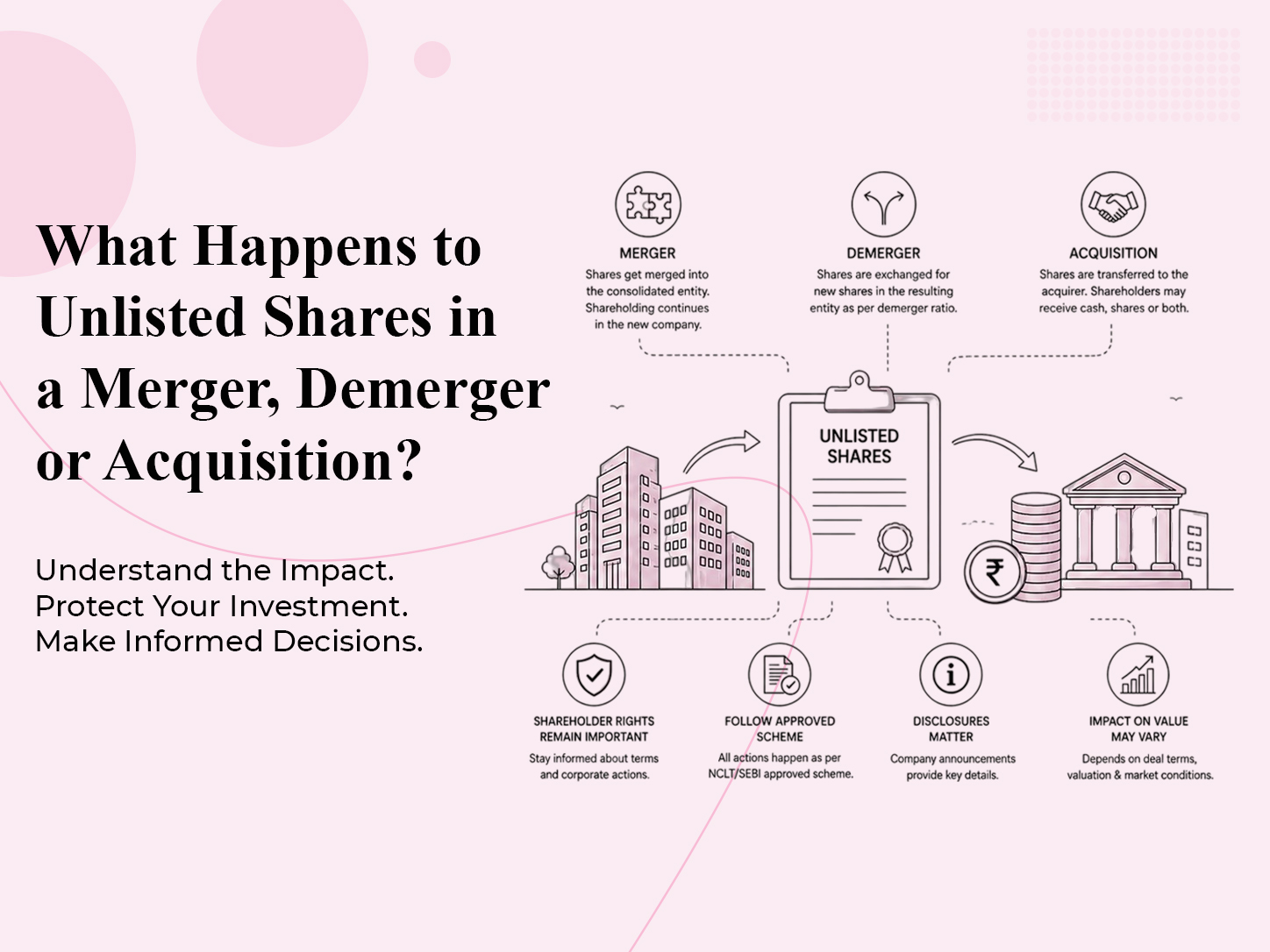
When two private companies combine, split apart, or one buys another, shareholders are often left with more questions than answers. What happens to unlisted shares in a merger depends entirely on the structure of the deal, the scheme of arrangement, the swap ratio, the mode of consideration, and the approvals involved. A merger is different from a demerger, and both are different from an acquisition, yet all three fall under the broad umbrella of corporate restructuring.
It's natural for shareholders to feel anxious when they hear that "their" company is merging with another entity, splitting into two, or being acquired. The uncertainty usually comes from not knowing whether shares will be cancelled, replaced, or paid out in cash. The honest answer is: it varies. Every restructuring event follows a legal process, and the final outcome for an investor is written into the approved scheme not decided informally. Understanding this process in advance helps shareholders read the fine print correctly instead of reacting to rumors.
This guide walks through mergers, demergers, acquisitions, ESOP treatment, shareholder protections, and the practical checklist every unlisted shareholder should use before signing off on any restructuring event.
These terms are often used interchangeably, but they describe distinct legal and financial events.
| Structure | What Changes | Shareholder Outcome |
| Merger | Two companies become one | Shares exchanged as per swap ratio |
| Demerger | One company splits into two | Shares issued in both resulting entities |
| Acquisition (Cash) | Ownership changes hands | Shareholders paid in cash |
| Acquisition (Stock) | Ownership changes hands | Shareholders receive acquirer's shares |
| Reverse Merger | Private company merges into another entity | Original shareholders get shares in combined entity |
| Business Transfer | Business assets/liabilities move | Company (not shareholders directly) receives consideration |
Restructuring events directly affect several things an unlisted shareholder cares about:
None of these outcomes are automatic; they depend on the specific scheme approved by the company and its regulators.
Quick answer: In most mergers, the shares of the merging (transferor) company are cancelled, and shareholders receive new shares of the resulting (transferee) company based on an approved exchange ratio. In some structures, shareholders may instead receive cash or a mix of cash and shares as merger consideration.
The typical sequence looks like this:
1.Board approval – Both companies' boards approve the draft scheme of arrangement.
2.Valuation and fairness opinion – Registered valuers assess both companies and recommend a swap ratio.
3.Shareholder and creditor approval – A required majority of shareholders and creditors vote to approve the scheme.
4.NCLT approval – The National Company Law Tribunal reviews and sanctions the scheme under the Companies Act, 2013.
5.Implementation – Old shares are cancelled or extinguished, and new shares are issued (or cash is paid) as per the sanctioned scheme.
Ownership doesn't simply "disappear" it converts into a new form as defined by the legally approved scheme.
The share exchange ratio (or swap ratio) determines how many shares of the new/resulting company a shareholder receives for each share held in the merging company. This ratio is derived from independent valuation reports and, where applicable, a fairness opinion from a merchant banker.
Valuers typically consider:
Simple example: If Company A is valued at ₹100 crore and Company B (the resulting entity) is valued at ₹400 crore, and both companies have 10 lakh shares outstanding, the swap ratio might work out to roughly 1 share of Company B for every 4 shares of Company A reflecting the relative value of each business.
Quick answer: In a demerger, a business division is carved out into a new, independent company. Existing shareholders usually receive shares in the newly created entity in the same proportion as their original holding, while continuing to hold shares in the original (now smaller) company.
Key points to understand:
Acquisitions of unlisted companies can be structured in several ways, and the outcome for shareholders depends heavily on which structure is used.
Cash Acquisition: Shareholders receive an agreed price per share in cash for their holding. Ownership in the company ends once the transaction settles.
Stock Acquisition: Shareholders receive shares of the acquiring company instead of cash, becoming shareholders in the acquirer.
Hybrid Acquisition: A combination of cash and stock, where shareholders receive part of their consideration in cash and part in the acquirer's shares.
Buyout: Often used when a private equity investor or promoter group buys out existing shareholders entirely, typically for cash.
Strategic Acquisition: A larger company acquires the target for synergies (technology, market access, talent), and terms can involve cash, stock, or earn-outs tied to future performance.
In every case, the acquisition agreement and shareholder approval process define exactly what each shareholder is entitled to.
Employees holding stock options face a slightly different situation than regular shareholders.
Employees should always read the specific ESOP scheme document rather than assuming a standard treatment applies.
Indian corporate law builds in several protections for shareholders during restructuring:
Where the company or a subsidiary is linked to public markets, SEBI regulations may also apply to disclosure and process requirements.
Individual shareholders cannot unilaterally block a merger once the required majority approves it. They can vote against the scheme, raise objections before the NCLT, or explore legal remedies for unfair treatment, but practical limitations mean most schemes proceed once statutory approval thresholds are met.
Shareholders holding a very small individual stake typically have limited leverage on their own, which is why reviewing the scheme carefully and voting collectively with aligned shareholders matters more than trying to block a deal alone.
Restructuring events can trigger tax implications, and treatment differs based on structure:
This is a general overview only. Shareholders should consult a qualified tax professional for guidance specific to their transaction.
Consider a simplified, fictional example. Company A is merging into Company B.
An investor holding 100 shares of Company A would receive:
100 × (2/3) ≈ 67 shares of Company B
At Company B's per-share value of ₹150, this works out to approximately ₹10,000 in value compared to the investor's original holding value of ₹10,000 in Company A (100 shares × ₹100). The swap ratio is designed to preserve relative value, though actual post-merger performance of Company B will determine whether the investment appreciates or depreciates going forward.
Before voting on or accepting any restructuring scheme, unlisted shareholders should review:
Corporate restructuring can feel unsettling for unlisted shareholders, but what happens to unlisted shares in merger, demerger or acquisition situations is never arbitrary it follows a defined legal process involving valuation, approvals, and disclosure. Whether shares are cancelled and reissued, swapped at a specific ratio, or converted into cash consideration, the outcome is documented in the approved scheme of arrangement.
Rather than reacting emotionally to news of a merger or acquisition, shareholders are better served by reviewing the valuation report, understanding the swap ratio, confirming the approval status of the scheme, and evaluating what the restructuring means for future liquidity and IPO prospects. Every deal is different, and the details matter far more than the headline.
Supremus Angel helps investors understand corporate actions, evaluate unlisted investment opportunities, and stay informed about important developments affecting Pre-IPO and unlisted shares.
1.What happens to unlisted shares in a merger?
Unlisted shares of the merging company are typically cancelled and replaced with new shares of the resulting company, based on an approved swap ratio, or exchanged for cash consideration depending on the scheme structure.
2.Will my shares be cancelled?
Yes, in most merger structures, original shares are cancelled and new shares are issued as per the approved scheme; this is a normal part of the legal implementation process, not a loss of your ownership.
3.Can I receive cash instead of shares?
Yes. Some mergers and most acquisitions offer cash consideration instead of, or alongside, new shares, depending on how the deal is structured and agreed upon by the companies involved.
4.How is the swap ratio calculated?
Independent registered valuers assess both companies using methods like net asset value, discounted cash flow, and comparable company analysis, then recommend an exchange ratio reflecting each company's relative value.
5.What happens during a demerger?
A business division is separated into a new company, and existing shareholders typically receive proportional shares in the new entity while retaining their shares in the original, now smaller, company.
6.What happens if the company later goes public?
If the resulting or acquiring company eventually lists on a stock exchange, shareholders' holdings become tradable in the public market, subject to any lock-in periods specified at the time of listing.
7.Can minority shareholders object?
Yes, minority shareholders can raise objections during the NCLT approval process if they believe the scheme is unfair or prejudicial, though the tribunal ultimately decides based on the overall fairness of the process.
8.Are acquisitions always beneficial?
Not necessarily. Outcomes depend on the acquisition price, the strategic fit, and the acquirer's future performance; some acquisitions create value for shareholders while others do not.
9.Do ESOP holders receive compensation?
Generally yes vested options are usually converted using the same swap ratio or replaced with equivalent value, though exact treatment depends on the specific ESOP scheme and acceleration clauses.
10.Is tax payable after a merger?
It depends on the structure. Share-for-share exchanges are often tax-neutral under specific conditions, while cash consideration is typically treated as a taxable transfer; a tax professional should be consulted for specifics.
11.What approvals are required for a merger in India?
Mergers require board approval, shareholder and creditor approval by the required majority, and final sanction from the National Company Law Tribunal (NCLT) under the Companies Act, 2013.
12.Does my ownership percentage change after a merger?
Yes, in most cases, since the resulting company has a different total share count and shareholder base the swap ratio is designed to preserve relative value, not necessarily the exact ownership percentage.
