
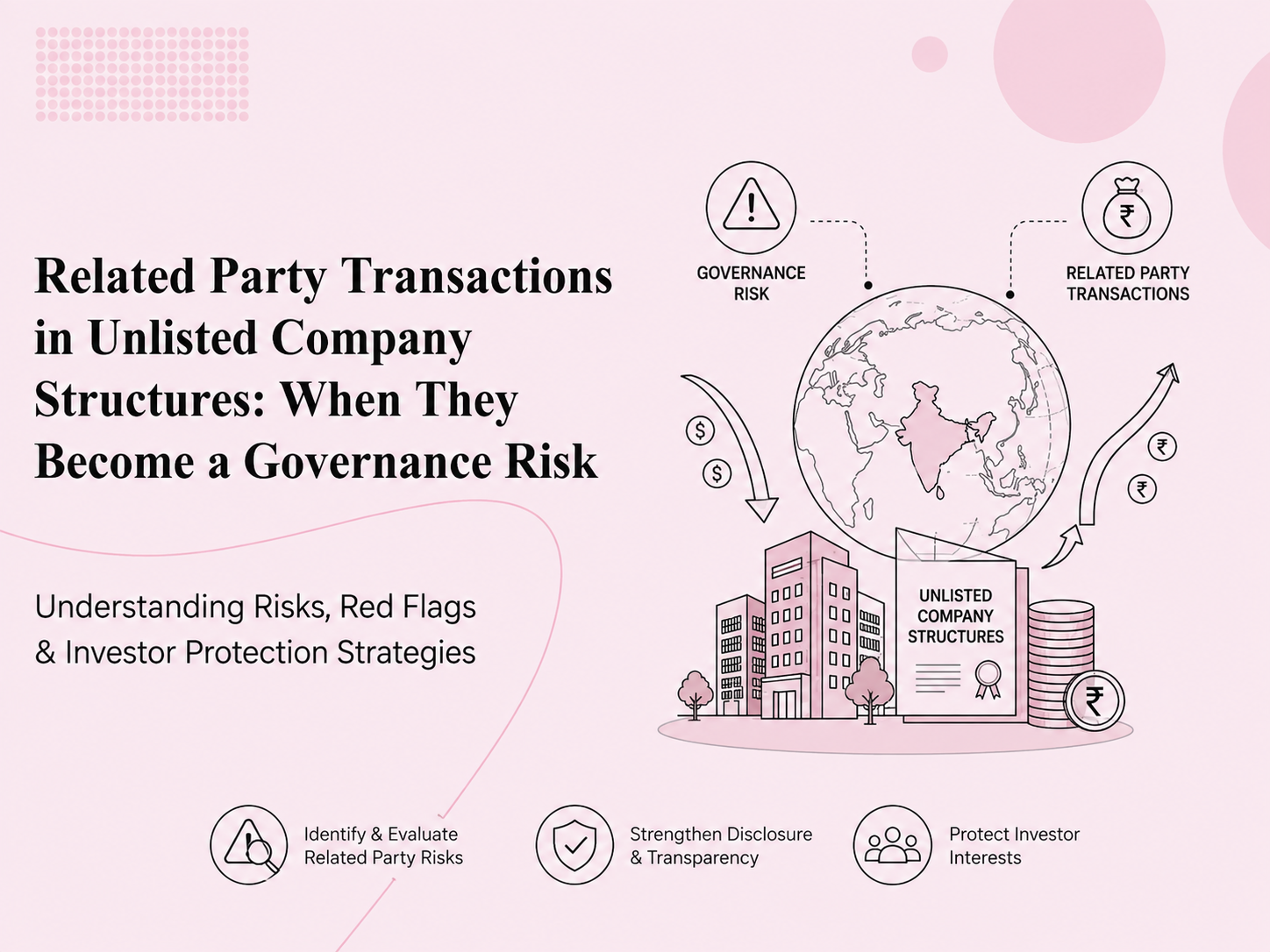
Related party transactions in unlisted companies refer to deals between a company and individuals or entities connected to its promoters, directors, or key management such as group companies, family members, or affiliated firms. These transactions are legal and common, but in unlisted companies, where disclosure norms are lighter than for listed peers, they can quietly shift value away from minority shareholders if left unexamined. Understanding how they work is essential before evaluating any pre-IPO or unlisted investment opportunity.
A related party transaction (RPT) is any transaction, sale, loan, service agreement, asset transfer, or investment between a company and a party that has a pre-existing relationship with it. In an unlisted company, related parties typically include:
Common examples include a company purchasing raw materials from a promoter-owned supplier, leasing office space from a director's personal entity, or extending loans to a group company at below-market interest rates.
RPTs themselves are not inherently problematic. Many are operationally necessary, especially in group structures where shared services, manufacturing, or distribution arrangements are common. The governance concern arises when these transactions are not conducted at arm's length, are inadequately disclosed, or are structured in a way that benefits the related party at the expense of the company and its minority investors.
For investors evaluating unlisted or pre-IPO companies, related party transactions matter for three core reasons.
1. Disclosure gaps are wider than in listed companies. Listed companies are governed by SEBI's Listing Obligations and Disclosure Requirements (LODR), which mandate audit committee approval, shareholder approval for material RPTs, and periodic disclosure. Unlisted companies are primarily governed by the Companies Act, 2013 rather than SEBI's continuous listing-related disclosure framework. While the Companies Act contains specific approval and disclosure requirements for related party transactions, investors generally have less continuous public visibility than they would for listed companies.
2. Value can be transferred outside minority shareholders' view. Pricing goods or services above or below market rates, routing revenue through a related entity, or transferring assets at non-market valuations can shift economic value away from the company without appearing as an obvious red flag on the surface.
3. It directly affects valuation and exit outcomes. If a company's reported profitability is inflated or deflated through related party arrangements, valuation multiples calculated on those numbers become unreliable. This has a direct bearing on pre-IPO entry pricing and future exit value.
Not every related party transaction indicates poor governance. The transition from routine to risky typically happens when the following factors are present.
Pricing that deviates from market rate When goods, services, or assets are transacted at prices materially different from what an independent third party would charge, it suggests the transaction is structured to benefit the related party rather than the business.
Lack of independent approval Related party transactions approved solely by promoter-controlled boards, without independent director review or audit committee scrutiny, carry higher governance risk.
Recurring and material transactions A one-off transaction is easier to assess than a pattern of recurring RPTs that make up a significant portion of revenue, expenses, or receivables.
Complex or layered structures Transactions routed through multiple group entities, cross-holdings, or circular arrangements often obscure the true economic substance of the deal.
Related party receivables that keep growing Rising balances owed by related parties, especially without clear repayment terms, can indicate that cash is being extended to group entities rather than reinvested in the business.
Limited disclosure in financial statements Vague descriptions of related party transactions in audited financials without naming the counterparty, transaction value, or basis of pricing reduce investor visibility significantly.
Investors evaluating an unlisted or pre-IPO company can apply a structured, sequential approach.
Step 1: Identify all related parties Review the related party disclosures in audited financial statements, typically found in the notes to accounts, to map out promoter entities, subsidiaries, and key management relationships.
Step 2: Quantify the scale of RPTs Calculate related party transactions as a percentage of total revenue, expenses, and balance sheet items. A rising trend over multiple years warrants closer scrutiny.
Step 3: Assess pricing basis Where disclosed, compare related party transaction pricing against comparable third-party transactions or industry benchmarks to check for arm's length consistency.
Step 4: Review approval mechanisms Check whether transactions were approved by independent directors or an audit committee, or solely by promoter-affiliated board members.
Step 5: Examine receivables and payables Track related party receivable and payable balances across multiple financial years to identify any unusual buildup or lack of settlement.
Step 6: Cross-check with statutory filings Where available, cross-reference related party disclosures with Registrar of Companies (RoC) filings, related entity financials, and auditor qualifications or remarks.
Step 7: Evaluate business rationale Assess whether the transaction serves a genuine operational purpose such as shared manufacturing or distribution or appears structured primarily for value transfer.
| Factor | What to Check | Good Sign | Red Flag |
| Pricing basis | Comparison with market/arm's length rates | Pricing aligned with comparable third-party rates | Significant deviation without justification |
| Approval process | Board and audit committee minutes | Independent director involvement in approval | Approval only by promoter-linked directors |
| Disclosure quality | Notes to financial statements | Detailed disclosure of parties, amounts, and terms | Vague or aggregated disclosures |
| Transaction trend | Multi-year RPT volume as % of revenue | Stable or declining proportion | Sharp, unexplained increase |
| Receivables/payables | Balance sheet related party balances | Regular settlement, low ageing | Growing, unsettled balances |
| Business rationale | Nature and necessity of transaction | Clear operational logic | Transaction with no evident business purpose |
| Auditor remarks | Auditor's report and qualifications | No adverse remarks on RPTs | Qualified opinion citing RPT concerns |
| Parameter | Listed Companies | Unlisted Companies |
| Regulatory framework | SEBI LODR + Companies Act, 2013 | Primarily Companies Act, 2013 |
| Disclosure frequency | Quarterly and annual, continuous | Annual, at time of financial filing |
| Shareholder approval | Mandatory for material RPTs | Required only above certain thresholds |
| Independent director review | Mandatory audit committee approval | Depends on company's board composition |
| Public visibility | High, via stock exchange filings | Limited, mainly through RoC filings |
This difference in oversight intensity is a core reason investors should evaluate related party transactions in unlisted company financials with more, not less, diligence than they would for listed peers.
Not all related party transactions warrant caution, and not all should be dismissed as governance failures. A practical way to frame the decision:
Proceed with normal diligence when:
Apply heightened scrutiny when:
Ultimately, related party transactions should be evaluated as one input among several governance structure, financial trends, and management track record all factor into the overall assessment. Investors should evaluate carefully rather than relying on the presence or absence of RPTs alone.
Supremus Angel operates as a platform for pre-IPO and unlisted share investments, and supports investors primarily through access to information and structured evaluation processes rather than investment recommendations.
Supremus Angel does not provide investment advice or guarantee outcomes. Investment decisions in unlisted and pre-IPO shares depend on company performance, governance quality, and broader market conditions, and investors should evaluate each opportunity independently or with the help of a qualified financial advisor.
1. What is a related party transaction in an unlisted company?
It is any transaction between the company and a connected party such as a promoter entity, director, or group company including sales, loans, leases, or service agreements.
2. Are related party transactions illegal?
Lack of independent oversight, where such oversight is applicable or available
3. Why are RPTs riskier in unlisted companies than listed ones?
Unlisted companies have fewer continuous disclosure obligations and less independent oversight compared to SEBI-regulated listed companies, making transparency more limited.
4. How can investors find related party transaction details for an unlisted company? Primarily through the notes to accounts in audited financial statements and filings available with the Registrar of Companies.
5. Do related party transactions affect company valuation?
Yes. If revenue, expenses, or receivables are influenced by non-arm's length RPTs, reported financial performance may not reflect the company's true underlying value.
6. What is an arm's length transaction?
It refers to a transaction priced as if conducted between unrelated, independent parties under normal market conditions.
7. Should investors avoid companies with related party transactions altogether?
Not necessarily. Many businesses have legitimate group-level RPTs. The focus should be on disclosure quality, pricing fairness, and approval processes rather than the mere presence of RPTs.
8. Does Supremus Angel verify related party transactions for listed opportunities? Supremus Angel provides access to available company information to support investor research, but does not offer investment advice or independently guarantee the accuracy of third-party disclosures. Investors are encouraged to conduct their own due diligence.
