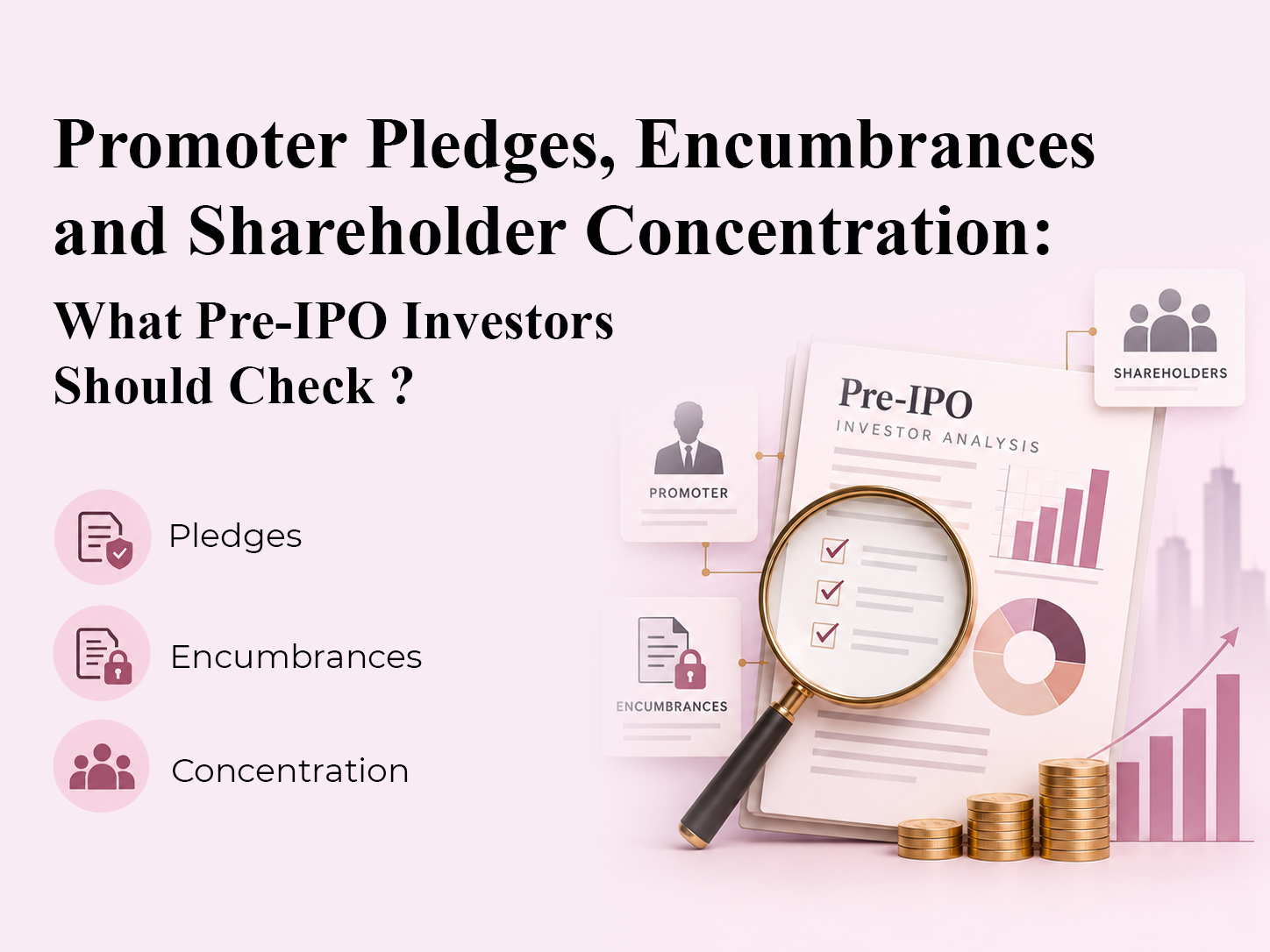
A promoter pledge unlisted company investors find in the records means founders have offered some of their own shares to a lender as security for a loan. It is not automatically a red flag, but it can affect who controls the business if repayment goes wrong. Before investing in pre-IPO shares, check three separate things: pledges, other encumbrances on shares, and how concentrated ownership is. This guide explains what each means, where to look, and how to read them together.
A pledge is a simple arrangement. A promoter hands over shares as security to a lender. The shares stay in the promoter's name, but the lender gets a claim over them until the loan is repaid.
Promoters pledge shares for many ordinary reasons. They may need funds for the company's expansion, personal liquidity, a group company's borrowing, or a bridge loan. In India, the general law of pledge sits in the Indian Contract Act, 1872, and for shares held in demat form, the Depositories Act, 1996 and depository rules govern how a pledge is recorded.
If the borrower defaults, the lender can usually invoke the pledge and sell the shares or take other steps, but only as the loan agreement and the law allow. Notice periods, cure rights and sale procedures differ from one deal to another.
A pledge does not prove distress or misconduct. Many healthy businesses have promoters who borrowed against their holdings. What matters is how large the pledge is, why it exists and whether the loan is serviceable.
A simple hypothetical: Suppose a founder owns 60 of every 100 shares and pledges 20 of them to a lender. The founder still votes those shares while the loan is serviced. If the loan defaults and the lender sells, the founder's holding could fall toward 40, and a new shareholder could appear.
An encumbrance is any restriction, charge or third-party right attached to shares. It is the wider category. A pledge is one type of encumbrance, but not every encumbrance is a pledge.
Other examples include:
An investor should ask four questions about any encumbrance: what is it, how many shares does it cover, who benefits, and what are its terms. A transfer restriction in favour of a co-investor carries very different risk from a lender's enforceable security. Lumping them together leads to wrong conclusions.
An IPO tends to work best when ownership is stable and the control structure is clear. Pledges can touch that in five ways:
The actual consequence always depends on the contract, the law and the circumstances. A small pledge backed by strong cash flows is a very different matter from a large one supporting a stressed borrower.
Shareholder concentration means a small number of holders control a large share of the equity or votes. Take a company where one promoter holds 55%, and two funds hold 15% each. Three parties decide almost everything.
Two things are worth separating:
Concentration can cut both ways. Under company law, a holder with more than 25% of the votes can generally block a special resolution, and one with more than 75% can pass one alone. That is real power. A single dominant promoter can also mean fast decisions and a clear vision. The risk appears when one person, fund or strategic holder becomes a single point of failure, or when the dominant shareholder's interests clash with those of minority holders, for example through related-party dealings.
So concentration is a question to examine, not a verdict.
Listed companies disclose promoter encumbrances at regular intervals under SEBI rules. Unlisted companies do not carry the same disclosure obligations, so you often have to assemble the picture yourself. Here is where to look:
Availability varies by company type and the rules that apply to it. If a company will not share basic ownership information, record that as a finding too.
These are prompts for questions, not proof of trouble.
1. A high or rising share of promoter holdings pledged
2. Unclear information about the beneficiary or terms
3. A large change in promoter holding with no clear reason
4. Heavy dependence on one shareholder or a small group
5. Possible conflict between promoter, lender and minority interests
Do not read each item in isolation. A modest pledge looks different when one promoter holds the vote and the loan is short-term. Connect the rows.
| What to Check | Why It Matters | Possible Concern | Follow-up Action |
| Pledge level and trend | Shows reliance on share-backed debt | Rising pledge over time | Ask for pledge history and loan purpose |
| Encumbrance terms | Defines what a lender or third party can do | Broad enforcement triggers | Request relevant agreement extracts |
| Promoter holding | Indicates alignment and control | Sharp unexplained drop | Trace transfers and dilution |
| Shareholder concentration | Reveals who really decides | Dependence on one or two holders | Map votes, board seats, special rights |
| Voting arrangements | Can shift control without share sales | Hidden veto or nomination rights | Read the shareholders' agreement |
| Ownership transfers | Signals ownership stability | Frequent or opaque transfers | Review registers and filings |
| Information transparency | Affects reliability of every other check | Incomplete or delayed answers | Document gaps and escalate to counsel |
The following is a fictional illustration with made-up numbers. It describes no real company.
Imagine "Company X," an unlisted firm. The promoter holds 48% of equity. Of that, 40% of the promoter's shares (about 19% of total equity) are pledged to a lender. Two outside investors hold 18% and 14%, a combined 32%.
How would an analyst read it?
The conclusion is not "avoid." It is: here are four documents and three questions to answer first.
A promoter holding 60% sounds reassuring. But if half of it is pledged, or two other holders can block key decisions, the headline number tells you little. Sound assessment combines pledges, encumbrances, concentration, financial position, governance quality and the documents you can actually verify.
If you are exploring pre-IPO shares, Supremus Angel's educational resources can help you understand these risks and build a due-diligence habit before you decide. No investment is risk-free, and an IPO is never guaranteed.
Disclaimer: This article is for education only and is not investment, legal or tax advice. Verify all information independently and consult qualified professionals before investing. Unlisted securities are illiquid and carry high risk.
1. What is a promoter pledge in an unlisted company?
It is when promoters offer their own shares to a lender as security for a loan. The shares generally stay in their name, but the lender gains rights over them if repayment fails, as the agreement allows.
2. Is a promoter share pledge always a red flag?
No. Promoters may pledge for expansion, liquidity or other legitimate needs. Assess the size, trend, purpose, lender terms and repayment capacity before drawing conclusions.
3. What happens if a promoter defaults on a loan secured by shares?
Depending on the agreement and law, the lender may sell or otherwise enforce the pledged shares after following required steps. This could reduce the promoter's holding and bring in new shareholders.
4. How are pledged shares different from encumbered shares?
A pledge is one kind of encumbrance. Encumbrance is the broader term, covering liens, non-disposal undertakings, transfer restrictions and third-party rights. Not every encumbrance gives a lender enforcement rights.
5. How can investors check promoter pledges in unlisted companies?
Review the cap table, annual reports, borrowing notes, MCA filings, shareholder agreements and depository records, and ask the company for written confirmation. Disclosure varies, so gaps themselves are worth noting.
6. Why does shareholder concentration matter before an IPO?
When few holders control most votes, their decisions or exits can shape the company significantly. It can speed decisions but also creates key-person and minority-interest risks worth examining.
7. Can a promoter pledge affect control of a company?
It can, if enforcement reduces the promoter's holding or transfers shares to others. The impact depends on the pledge's size, loan terms and who else holds substantial voting power.
8. What should investors check before buying pre-IPO shares?
Check ownership, pledges, encumbrances, voting arrangements, transfer restrictions, financials and governance history. Confirm the source and date of each document, and take legal and financial advice where appropriate.
9. Does a high promoter holding always mean lower investment risk?
No. A large holding may show commitment, but it can be pledged, concentrated or tied to control issues. Ownership percentage is only one input alongside financial and governance quality.
10. What documents should be reviewed before a pre-IPO investment?
Look at the cap table, audited financials, annual return, articles of association, shareholders' agreement, borrowing and security notes, depository statements and any written confirmations on pledges.
