
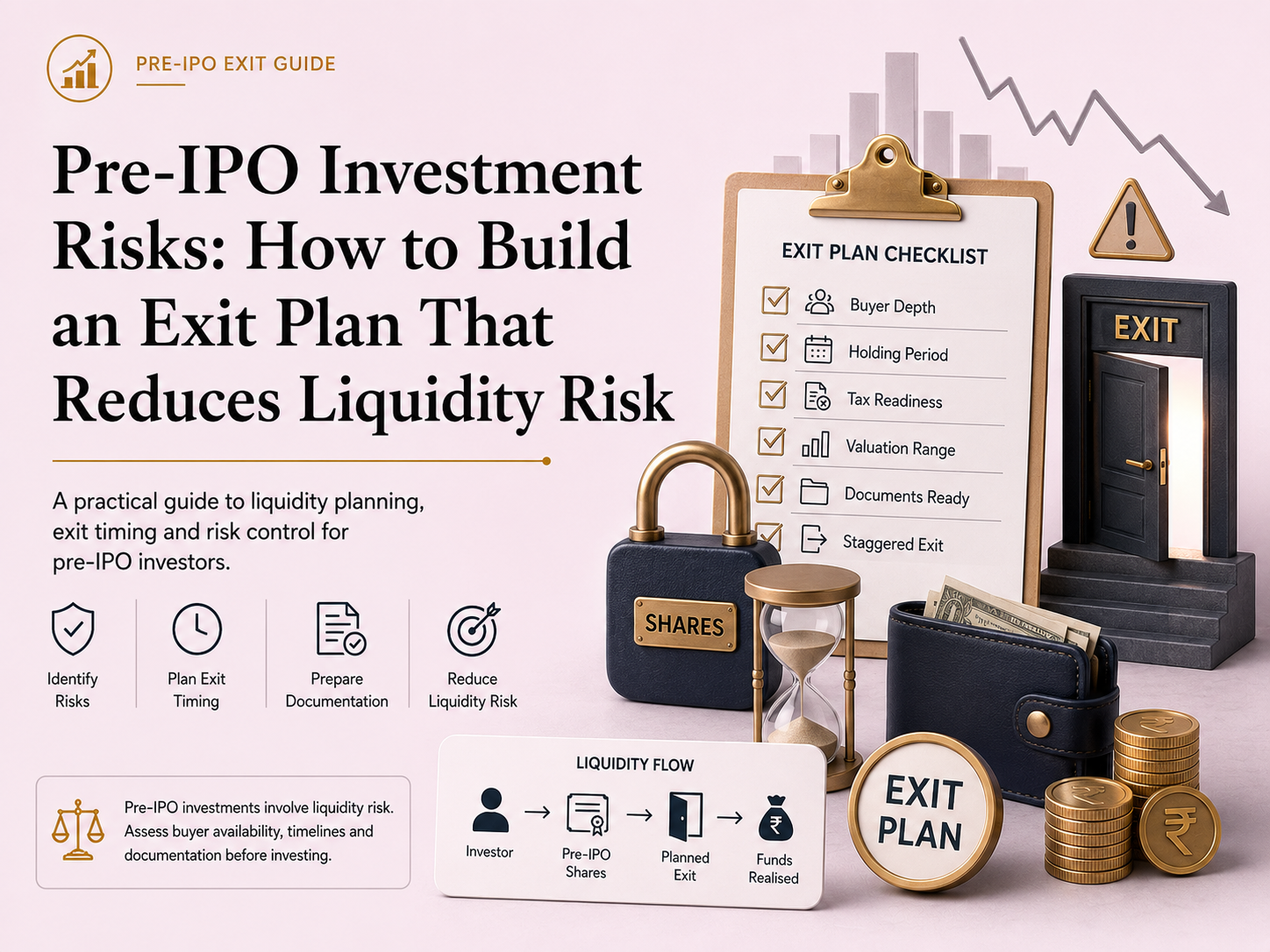
An exit plan for unlisted shares is a practical strategy that defines how, when and under what conditions an investor may sell a Pre-IPO holding. It sets out the expected holding period, realistic selling price, possible buyers, preferred exit route, backup options and acceptable settlement timeline.
Without this preparation, investors may become dependent on an IPO, a single buyer or an uncertain future valuation. A well-planned exit strategy cannot guarantee liquidity, but it can reduce the risk of being forced to sell at an unfavorable price or hold the investment longer than expected.
Here is a practical framework for building an exit plan before investing in unlisted shares.
Before analyzing a company’s expected IPO, valuation or growth potential, decide what you expect the investment to achieve.
Different objectives require different exit strategies. One investor may want to hold until the company lists. Another may prefer to sell through the secondary market after the business reaches a particular valuation. A third may plan to recover part of the capital through a partial exit while retaining the remaining shares.
Start by writing down:
Your preferred and maximum holding periods should not be the same.
For example, you may expect to exit after three years but remain financially comfortable holding the investment for five years. This additional flexibility matters because IPO schedules, funding rounds and buyer demand can change.
A useful question is not simply, “When is the company expected to list?”
It is:
“How long can I continue holding these shares if the expected listing does not happen?”
The answer establishes whether the investment fits your actual financial situation rather than an optimistic timeline.
The amount invested can have a direct effect on how easily the position may be sold later.
A large quantity may appear attractive when the purchase price is favorable, but it can become difficult to place if buyers usually prefer smaller lots. A quoted price for 500 shares does not necessarily mean that 20,000 shares can be sold at the same price.
Before investing, examine:
Suppose buyers commonly purchase between 1,000 and 2,500 shares, but an investor acquires 15,000 shares. A complete exit may require several buyers, multiple transfers or a discount for a single block sale.
That does not automatically make the investment unsuitable. It means the investor should structure the position with the future buyer market in mind.
A practical approach is to avoid investing an amount that can only be sold through one large transaction unless there is credible evidence of sufficient buyer capacity.
A displayed unlisted-share price shows only one part of the market. It may represent a seller’s asking price, an indicative quote or an old transaction reference. It does not necessarily confirm that a buyer is ready to purchase your quantity.
Before investing, ask for evidence of real buyer demand.
Useful questions include:
Buyer activity should ideally be observed over a reasonable period rather than on one particular day.
A sudden rise in interest may be linked to an IPO rumour, a funding announcement or temporary market excitement. If that interest disappears, the investor may be left with limited options.
The objective is not to prove that the shares will always remain liquid. It is to understand whether the market has consistent, two-way participation or only occasional interest.
An exit plan should be based on what may realistically be received after a transaction, not only on the most visible market quote.
Separate these three prices:
The difference between the seller’s asking price and the buyer’s bid is the bid-ask spread.
Consider an illustrative example:
An investor should not automatically assume that ₹500 is immediately realisable. The executable market may be closer to the buyer bid or recent transaction price.
The estimated net exit value should also account for:
This calculation prevents a paper valuation from being mistaken for money that can be accessed immediately.
A strong exit plan should not rely on one expected outcome. Build at least three scenarios before investing.
This is the outcome you consider reasonably likely.
The company may continue meeting financial targets, complete another funding round or make steady progress towards an IPO. Under this scenario, you may exit through a secondary buyer, a company-supported liquidity event or after listing.
Define:
In this scenario, the business may continue operating normally, but the expected IPO, funding round or liquidity programmed takes longer than anticipated.
Your plan should state:
An IPO delay does not necessarily mean the company has failed. However, it changes when your capital may become available.
This scenario assumes that conditions become less favorable.
Possible developments may include:
Decide in advance whether you would:
The purpose of stress planning is not to predict the worst outcome. It is to prevent emotional decisions when circumstances change.
A target return and an exit deadline are not the same.
The shares may reach your preferred price earlier than expected. They may also remain below that price when you need access to the capital.
Your exit plan should therefore identify which factor has priority.
Ask:
For example, an investor may expect a 50% return over four years but receive an opportunity to exit at a 35% gain after two years. The appropriate decision depends on company performance, valuation, alternative opportunities, tax implications and the investor’s financial goals.
A return remains theoretical until a transaction is completed. That is why an exit plan should focus on executable value rather than only a headline valuation.
Selling an entire holding in one transaction is not always necessary.
A partial exit may allow an investor to release some capital while continuing to participate in the company’s future growth. It can also reduce dependence on one buyer, one price and one corporate event.
For example, an investor holding 10,000 shares may plan to:
Partial exits can help:
However, this strategy works only when smaller transactions are permitted and economically practical.
Before relying on partial exits, confirm:
Depending entirely on one future event increases the risk of being unable to exit as planned.
A better strategy includes one preferred route and at least one realistic backup.
Shares may be sold to another eligible investor through an off-market transfer.
This route depends on:
Compare genuine buyer bids instead of relying only on displayed prices.
A portion of the position may be sold to recover capital or reduce concentration while retaining the remaining shares.
This route may be useful when demand exists for smaller quantities but not the entire holding.
A new funding round may create interest from incoming investors or provide a liquidity opportunity for existing shareholders.
However, participation is not automatic. It depends on the company, investors and transaction terms.
Some companies may announce buybacks, tender offers or shareholder liquidity programmers.
These events can create a direct exit route, but they should never be treated as guaranteed. Pricing, eligibility and quantity limits depend on the specific offer.
A strategic buyer, institution or large investor may purchase a substantial block.
This route may suit investors with larger positions, although due diligence, negotiation and settlement may take longer.
An IPO may create access to an exchange-traded market, but it should not be considered an assured or immediate exit.
The investor may still need to consider:
A practical exit plan should remain workable even when the IPO happens later than expected.
One of the most effective ways to reduce the pressure of illiquidity is to keep sufficient liquid assets outside the unlisted-share portfolio.
Avoid using money allocated for:
An investor who urgently needs cash has less negotiating power. The investor may be forced to accept a lower bid, sell an inconvenient quantity or transact with the first available buyer.
Before investing, calculate:
Unlisted shares should form part of a broader portfolio plan, not replace money required for financial stability.
A buyer may be available, but incomplete records can delay the transaction.
Maintain a clear investment file containing:
Verify that the company name, security type, ISIN and quantity appearing in the demat account are correct.
Investors should also examine whether the company’s articles of association or shareholder agreements contain transfer restrictions, rights of first refusal or approval requirements.
Holding unlisted equity shares can also affect the income-tax return form available to an investor. The Income Tax Department states that an individual who held unlisted equity shares during the relevant previous year cannot use ITR-1, and similar restrictions apply to ITR-4 eligibility. Tax treatment and filing requirements depend on the investor’s circumstances, so professional guidance may be appropriate. (Income Tax Department)
An exit plan should not remain unchanged from the purchase date until the sale.
Review it every six to twelve months and after important company or personal developments.
Update the plan when:
During every review, compare the investment with other available opportunities. Continuing to hold should remain an active decision rather than the result of having no exit process.
| Factor | What to Check | Positive Sign | Warning Sign |
| Buyer enquiries | Frequency of genuine demand | Consistent enquiries from several buyers | Rare or unclear buyer interest |
| Executable quotes | Availability of active buyer bids | Quotes are available regularly | Only seller asking prices are visible |
| Bid-ask spread | Difference between buyer and seller prices | Relatively narrow and stable | Wide or rapidly increasing |
| Recent transactions | Completed price, date and quantity | Verifiable recent transfers | No reliable transaction evidence |
| Buyer concentration | Number of independent buyers | Multiple buyer channels | Dependence on one buyer |
| Lot-size flexibility | Ability to sell different quantities | Small and large lots accepted | Only one specific quantity is accepted |
| Partial-exit potential | Ability to sell part of the holding | Smaller transfers are practical | Full-position sale is required |
| Alternative routes | Secondary sale, funding round or buyback | More than one realistic option | Exit depends entirely on IPO |
| Documentation | Purchase, demat and KYC records | Complete and organised | Missing ownership or acquisition proof |
| Holding capacity | Time capital can remain invested | Flexible multi-year period | Capital may be required soon |
| Transfer terms | Restrictions and settlement steps | Clear and documented process | Unclear or disputed conditions |
| Company progress | Financial and governance developments | Fundamentals remain supportive | Deterioration or unexplained delay |
No single factor should determine the investment decision. The purpose of this scorecard is to identify where the exit plan is strong and where further verification is necessary.
Before investing, answer each of the following questions:
The more questions you can answer clearly, the more practical the plan is likely to be.
The investment may require reconsideration when:
The objective is not to eliminate uncertainty. It is to understand the uncertainty before committing capital.
Supremus Angel helps investors explore available Pre-IPO and unlisted-share opportunities, understand indicative market quotes and review the practical steps involved in buying or selling shares.
Investors may use the available information to examine lot sizes, transaction documentation, potential buyer or seller availability and possible exit routes. This can make it easier to compare opportunities and ask relevant questions before proceeding.
However, an indicative quote cannot guarantee execution, liquidity, investment returns or an IPO timeline. Share availability and pricing may change according to buyer demand, company performance and market conditions.
Every investment decision should remain subject to independent due diligence, financial suitability and professional legal or tax guidance where required.
Reducing liquidity risk in a Pre-IPO investment begins with planning the exit before purchasing the shares.
A practical exit plan defines the investment objective, preferred and maximum holding periods, likely buyers, executable price range and alternative routes. It also considers position size, partial exits, documentation, tax readiness and the possibility that the expected IPO may be delayed.
Investors should avoid depending on one buyer, one quoted price or one future corporate event. They should also maintain sufficient liquid savings outside the unlisted-share portfolio so that a financial emergency does not result in a forced discounted sale.
Company growth may improve the potential value of a holding, but value and liquidity are different. The final outcome depends on company performance, buyer demand, market conditions, transfer requirements and the investor’s ability to wait.
Supremus Angel can support the opportunity-evaluation and transaction-understanding process, but independent due diligence remains essential.
Can unlisted shares be sold before an IPO?
Yes. Unlisted shares may be sold through an eligible off-market secondary transaction when a genuine buyer is available and the required transfer process is completed.
Should an IPO be the only exit route?
No. Investors should also evaluate secondary sales, partial exits, funding-round liquidity, company buybacks and strategic transactions where realistically available.
Is a displayed unlisted-share price guaranteed?
No. A displayed price may be indicative and does not guarantee execution at the same price, for the full quantity or within a particular timeline.
How can an investor estimate an exit price?
Compare the seller’s asking price, active buyer bids and recent completed transactions. Fees, taxes, lot size and any discount required for faster execution should also be considered.
Can investors sell only part of their holding?
Potentially, yes. Partial exits depend on buyer demand, preferred lot sizes, transfer restrictions and transaction costs.
How long does it take to exit an unlisted investment?
There is no fixed timeline. It depends on buyer availability, quantity, agreed pricing, documentation, company restrictions and settlement arrangements.
What happens when an IPO is delayed?
The investor may continue holding, seek a secondary buyer or consider a partial exit. The exit plan should define how much delay the investor can tolerate before purchasing the shares.
How often should an exit plan be reviewed?
It should generally be reviewed every six to twelve months and after major financial, governance, funding, IPO or personal developments.
What documents are required when selling unlisted shares?
Investors should generally maintain purchase records, payment proof, demat statements, KYC details, acquisition information, corporate-action records and relevant tax documents.
Does a high company valuation guarantee liquidity?
No. Valuation and liquidity are separate. A company may have an attractive reported valuation but limited immediate buyer demand.
Disclaimer: This article is intended for educational and informational purposes only. It does not constitute investment, legal, tax or financial advice. Investments in Pre-IPO and unlisted shares involve company-specific, valuation, liquidity, market and regulatory risks. Investors should conduct independent due diligence and consult qualified professionals before making an investment or transaction decision.
