
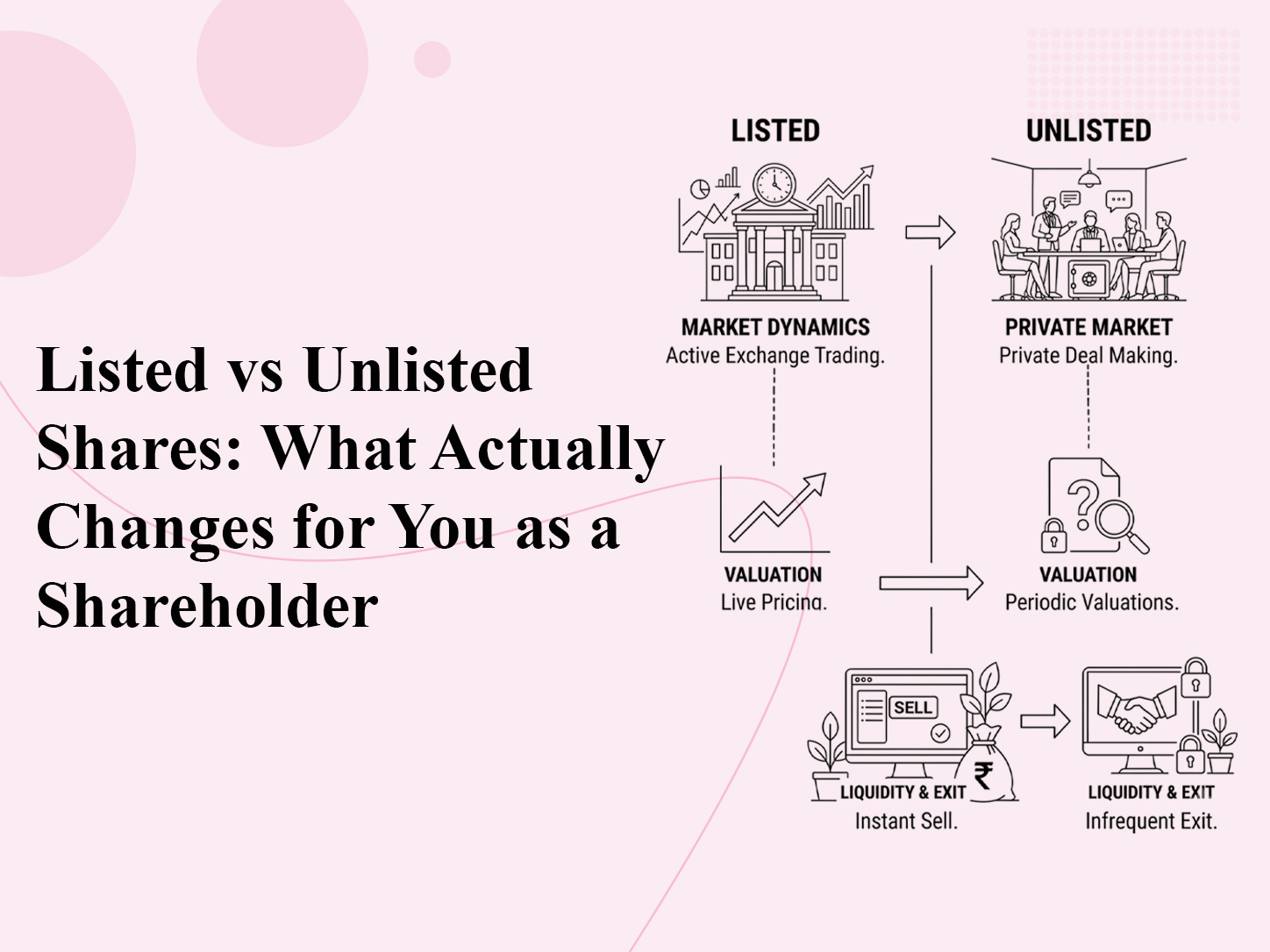
The difference between listed and unlisted shares goes beyond whether a company's stock appears on a public exchange. For a shareholder, the distinction affects how easily shares can be bought or sold, how prices are discovered, how transactions are transferred, and how taxation may apply.
Listed shares generally have continuous exchange-based price discovery and greater liquidity, while unlisted shares are traded through private transactions and may have more limited liquidity. Understanding these shareholder-level differences can help investors evaluate the practical implications of holding either type of security.
The simplest distinction is where the shares are traded.
Listed shares are securities admitted for trading on a recognised stock exchange, such as the NSE or BSE in India. Their prices are typically visible during market hours, and investors can generally place buy or sell orders through their brokers.
Unlisted shares are shares of companies that are not currently listed on a recognised stock exchange. They may include shares of private companies as well as companies preparing for a potential future listing. Transactions generally occur through private arrangements rather than through an exchange order book.
The distinction matters because the same basic ownership right can come with very different practical experiences.
| Shareholder Factor | Listed Shares | Unlisted Shares |
| Trading venue | Recognised stock exchange | Private / off-market transaction |
| Price visibility | Generally continuous during market hours | Less frequent and transaction-dependent |
| Liquidity | Usually higher | Usually lower |
| Price discovery | Exchange order book | Negotiated / private-market transactions |
| Transfer process | Typically through exchange and demat infrastructure | Often through off-market demat transfer |
| Transaction frequency | High for actively traded securities | Can be limited |
| Information availability | Broad public disclosures and market data | Depends on company disclosures and available records |
| Exit timing | Generally easier, subject to market liquidity | May take longer and depend on finding a buyer |
This does not mean every listed share is highly liquid or every unlisted share is difficult to sell. Liquidity depends on the specific security, company, demand, transaction restrictions and market conditions.
The listed vs unlisted shares distinction becomes important when considering what happens after purchasing the security. An investor is not simply choosing between two labels — they are choosing a different ownership environment.
Liquidity refers to how readily an asset can be converted into cash without materially affecting the price.
A listed share with active trading volume may allow an investor to sell through the exchange during market hours. An unlisted share generally does not provide the same exchange-based exit mechanism.
For an unlisted shareholder, an exit may depend on:
Therefore, an investor evaluating an unlisted share should consider the potential holding period rather than assuming an immediate exit will be available.
Listed shares have an observable market price generated through orders from buyers and sellers. For example, if a listed stock is trading at ₹250, that quoted price provides a visible reference point for current market transactions.
Unlisted shares do not have the same continuous exchange-based mechanism. Their price may be influenced by:
Consequently, a quoted unlisted share price should not automatically be interpreted as equivalent to an exchange-determined market price.
Tax treatment can differ between listed and unlisted securities. For Indian investors, the holding-period classification and applicable tax treatment should be checked based on the current provisions of the Income-tax Act, the nature of the security and the transaction circumstances.
As a general framework, the holding period relevant to capital gains classification has historically differed between listed and unlisted securities. Current rules should always be verified before making a transaction because tax provisions can change.
Investors should also consider transaction-related taxes and charges. For example, Securities Transaction Tax (STT) is associated with specified transactions in listed securities and does not generally apply in the same manner to private off-market transactions.
Taxation should therefore be evaluated independently rather than assuming that the treatment of a listed share automatically applies to an unlisted share.
Listed shares are ordinarily purchased and sold through exchange-linked brokerage and demat infrastructure. Unlisted shares may be transferred through an off-market demat transaction, subject to applicable requirements.
The transfer process can involve details such as:
For investors considering unlisted shares, understanding the actual transfer process before entering a transaction is important.
The difference between listed and unlisted shares can be understood through five practical shareholder attributes.
Liquidity. Listed securities generally provide greater liquidity because an exchange connects buyers and sellers. However, listing does not guarantee liquidity — a thinly traded listed stock may still have limited buyers. Unlisted shares generally have a narrower pool of potential buyers, which can make the exit process less predictable.
Price discovery. Listed securities benefit from an observable order-driven market. For unlisted shares, valuation and transaction pricing can involve negotiation and privately available information. This can create a greater need for investors to understand how a quoted price was determined.
Holding period. An investor should consider how long the capital may remain invested. With listed shares, the ability to sell during trading hours generally gives investors greater flexibility. With unlisted shares, the investment may require greater patience because a suitable secondary transaction may not be immediately available.
Information availability. Listed companies are subject to extensive disclosure and reporting requirements applicable to listed entities. Unlisted companies can have different disclosure environments, so investors may need to examine available financial statements, corporate information, shareholder documentation and other relevant records more carefully.
Transfer and settlement. Listed transactions generally occur through the exchange ecosystem and associated settlement mechanisms. Unlisted transactions can occur directly between parties through an off-market transfer process, subject to applicable rules and documentation.
| Factor | Listed Shares | Unlisted Shares |
| Market access | Exchange-based | Private / off-market |
| Price | Publicly quoted | Usually privately quoted or negotiated |
| Liquidity | Generally higher | Generally lower |
| Price discovery | Continuous market mechanism | Negotiated / private-market mechanism |
| Exit | Usually easier when liquidity exists | Depends on buyer availability |
| Volatility | Visible market volatility | Less frequent observable pricing |
| Disclosure | Extensive listed-company requirements | Varies by company and applicable regulations |
| STT | Applicable to specified transactions | Generally not applicable in the same manner |
| Transfer | Exchange / broker infrastructure | Off-market transfer mechanisms |
| Investor focus | Liquidity and market valuation | Valuation, liquidity, transferability and company fundamentals |
A useful analysis should begin with the investor's actual ownership experience rather than simply asking which category is better.
Step 1: Identify the security. Confirm exactly what security you are purchasing — company name, security type, ISIN (where applicable), face value, number of shares, current ownership structure, and whether the company is listed or unlisted. This avoids confusion between similarly named securities or entities.
Step 2: Understand the transaction price. For listed shares, compare the proposed purchase price with the current exchange price and relevant market data. For unlisted shares, determine how the quoted price has been established: When was the price last transacted? What valuation basis supports the price? Is there a recent funding round? Are there comparable transactions? How does the valuation compare with company fundamentals? A price without context is not enough for meaningful analysis.
Step 3: Assess liquidity. Do not treat liquidity as an assumption. For listed shares, examine trading volume and bid-ask spreads. For unlisted shares, consider historical transaction activity, the potential buyer pool, transfer restrictions, expected holding period and possible exit routes. The key question is not simply "Can I sell?" but "Under what circumstances could I realistically sell?"
Step 4: Review company fundamentals. The absence of exchange trading does not eliminate the importance of fundamentals. Review revenue, profitability, cash flow, debt, business model, competitive position, management, valuation and future funding requirements. An unlisted investment should not be evaluated solely on expectations of a future IPO.
Step 5: Evaluate tax implications. Determine the applicable capital gains classification, tax rate and transaction-related taxes based on current Indian tax rules. If the transaction has significant tax implications, professional tax advice may be appropriate.
Step 6: Understand the transfer process. Before purchasing unlisted shares, understand how the securities will be transferred and what documentation is required — demat details, transfer instructions, consideration amount, applicable charges, documentation and any restrictions affecting transferability.
Step 7: Consider your exit scenario. Create a realistic exit framework. Who could potentially buy the shares? How frequently do transactions occur? Is there a potential corporate event? Could liquidity remain limited for an extended period? What happens if the expected exit event does not occur? This step is particularly important when evaluating private or pre-IPO securities.
| Factor | What to Check | Good Sign | Red Flag |
| Company fundamentals | Revenue, profits, cash flow | Consistent underlying performance | Weak or unexplained financials |
| Valuation | Basis of current price | Supported by relevant data | Price based only on speculation |
| Liquidity | Trading or transaction history | Evidence of genuine demand | No identifiable exit route |
| Ownership | Shareholding structure | Clear ownership records | Unclear or inconsistent records |
| Transferability | Restrictions and process | Clearly documented process | Significant unexplained restrictions |
| Tax | Applicable rules | Tax treatment understood | Assumptions based on outdated rules |
| Documentation | Transaction records | Complete documentation | Missing or inconsistent documents |
| Future plans | Corporate developments | Clearly communicated plans | Reliance solely on rumours |
| Information | Financial and corporate data | Adequate information available | Limited verifiable information |
| Exit | Potential buyer / market | Multiple possible routes | No realistic exit mechanism |
Assuming listed always means liquid. Listing creates access to an exchange, but it does not guarantee strong trading activity. A listed stock with very low volume can still be difficult to exit at the desired price.
Treating an unlisted quote as a market price. An unlisted share may have a quoted transaction price, but that does not mean it has the same price-discovery mechanism as an exchange-traded stock. Investors should understand the source and basis of the quotation.
Focusing only on a potential IPO. Pre-IPO shares often attract attention because of a possible future listing. However, an IPO is not guaranteed, and its timing, valuation and eventual market performance can differ from expectations. The underlying company should therefore be evaluated independently of a potential listing event.
Ignoring the holding period. An investor may focus heavily on entry valuation while overlooking how long the capital could remain invested. For unlisted shares, this can be particularly important because secondary liquidity may be limited.
Using outdated tax information. Tax rules can change. Investors should verify the applicable provisions for the financial year and transaction rather than relying on an old article, social-media post or informal explanation.
Comparing prices without comparing valuations. A lower per-share price does not automatically mean a company is cheaper. Share price must be considered alongside the number of shares, valuation, capital structure and financial performance.
There is no universal answer to whether listed or unlisted shares are better. The more useful question is which structure fits the investor's requirements, time horizon and ability to tolerate limited liquidity.
Listed shares may be more suitable when:
Unlisted shares may warrant consideration when:
Neither category should be considered inherently superior. The appropriate evaluation depends on the specific company, security, valuation and investor circumstances.
An unlisted share deserves deeper analysis when the investor can answer several practical questions clearly.
Supremus Angel focuses on providing access to information and transaction opportunities in the pre-IPO and unlisted-share segment. For investors researching private-market securities, a platform can help organise information around available opportunities, transaction details and relevant company information.
However, platform availability does not remove the need for independent evaluation. Investors should review the underlying company, valuation, transaction structure, liquidity considerations, applicable taxes and potential exit scenarios before making an investment decision. The objective should be informed evaluation rather than treating an unlisted opportunity as equivalent to an exchange-traded security.
The difference between listed and unlisted shares is most meaningful when viewed from the shareholder's perspective. The main differences include:
The important point is that listing status changes the practical experience of ownership. Investors evaluating either category should look beyond the headline price and assess valuation, fundamentals, liquidity, transferability, taxation and exit possibilities together.
Comparing listed and unlisted shares should not stop at the question of whether a stock has an exchange ticker. For shareholders, the more important differences concern how the price is discovered, how easily the investment can potentially be sold, how the shares are transferred, how taxation applies and what information is available for evaluation.
Listed securities generally provide a more transparent and liquid trading environment. Unlisted securities require greater attention to valuation, documentation, liquidity and exit planning.
For investors exploring the unlisted and pre-IPO segment, the strongest approach is to evaluate each opportunity on its own fundamentals rather than assuming that a future listing, current quote or market narrative determines its value. Careful analysis remains essential because the outcome of any investment depends on the company, valuation, market conditions and other factors.
1. What is the difference between listed and unlisted shares? Listed shares trade on recognised stock exchanges, while unlisted shares are not currently traded on such exchanges. This difference affects liquidity, price discovery, transfer mechanisms and the availability of market information.
2. Are unlisted shares riskier than listed shares? Risk cannot be determined solely by listing status. Unlisted shares may involve additional liquidity and valuation challenges, while listed shares are exposed to market volatility and other investment risks. The specific company and security need to be evaluated.
3. Are unlisted shares less liquid than listed shares? Generally, yes. Listed shares can usually be sold through an exchange when sufficient market liquidity exists. Unlisted shares generally require an off-market transaction or another available exit route.
4. How is the price of an unlisted share determined? An unlisted share price may be influenced by company valuation, recent transactions, financial performance, investor demand, comparable companies and other factors. Unlike listed shares, there is no continuous exchange order book establishing the price.
5. Is STT applicable to unlisted shares? STT applies to specified securities transactions under the applicable tax rules. It does not generally apply to unlisted-share transactions in the same way as specified exchange-traded transactions. Investors should verify the treatment applicable to their particular transaction.
6. Can unlisted shares be held in a demat account? Yes, eligible unlisted securities can generally be held in dematerialised form, subject to the applicable requirements and the nature of the security.
7. How are unlisted shares transferred?
Unlisted shares held in dematerialised form may be transferred through an off-market demat transaction, subject to applicable documentation, procedures and regulations.
8. Are unlisted shares taxed differently from listed shares?
The tax treatment can differ based on factors including the type of security, holding period and applicable tax provisions. Investors should check the current rules applicable to the relevant financial year.
9. Are pre-IPO shares the same as listed shares?
No. Pre-IPO shares are unlisted securities issued by or representing ownership in a company that may potentially seek a public listing. Until listing occurs, the shares do not have the same exchange-based trading mechanism as listed securities.
10. Is listed or unlisted better for investors?
Neither is universally better. Listed shares generally offer greater liquidity and price visibility, while unlisted shares can provide access to companies before a potential listing. The appropriate choice depends on the specific investment, valuation, liquidity expectations, holding period and investor circumstances.
