
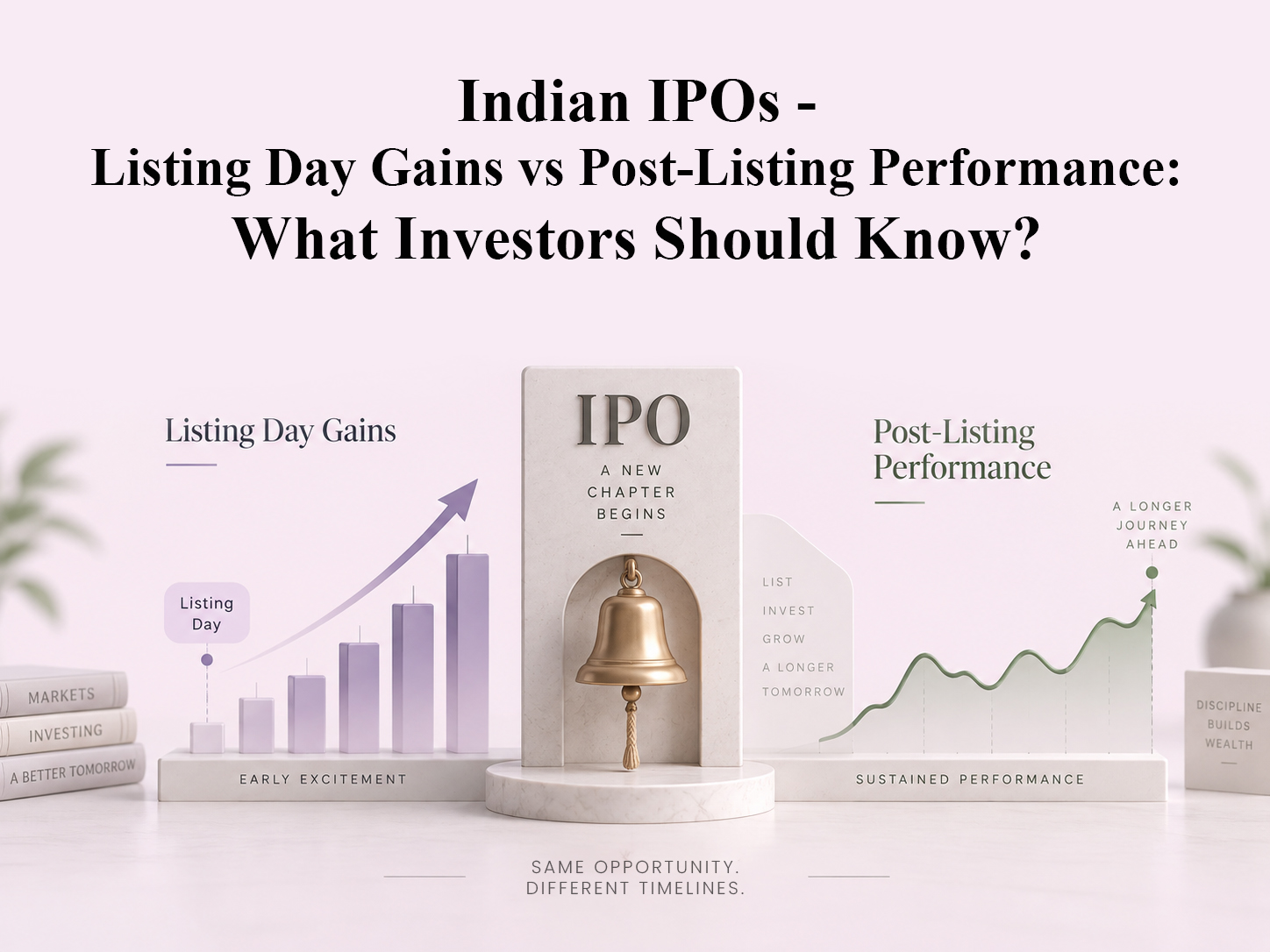
If you have ever tracked pre IPO returns in India, you already know the first-day headline rarely tells the whole story. A stock can list at a 40 to 60 percent premium and still be trading below its issue price six months later, while a quiet, modestly received listing can quietly compound into a solid long-term holding. Looking at 2025's IPO batch, roughly two out of three issues listed in the green, yet by the end of the year, well over half of them had slipped below their listing price. This gap between day-one excitement and medium-term reality is exactly what pre-IPO investors need to understand before they apply for the next issue, or before they exit shares they already hold.
Listing day price action is driven by a narrow set of forces: how the IPO was subscribed, how much grey market premium built up in the days before listing, and how much liquidity is chasing the stock in the first few hours of trade. None of that has much to do with the company's actual earnings trajectory, its competitive position, or how sustainable its margins are.
After listing, investors need to monitor several factors, including anchor-investor unlocks, applicable lock-in periods for promoters and other pre-IPO shareholders, and the company's quarterly financial performance. These events can affect the available supply of shares and, in some cases, influence short-term price movements.
Recent data on Indian mainboard IPOs makes the pattern fairly explicit. About 65 percent of issues listed at a premium and roughly 23 percent listed below their issue price, with the rest flat. The median listing-day gain across the year was a modest 3.8 percent, far lower than the eye-catching 50 to 75 percent pops that get most of the headlines. A handful of companies, including a highway construction and tolling firm, a home services platform, and a consumer internet company, delivered listing gains in the 45 to 75 percent range and generated most of the buzz.
By the end of the year, though, the picture had shifted meaningfully. A majority of 2025 IPOs, more than half, were trading below their listing-day price. Some of the biggest opening-day winners cooled off considerably, while a few companies that listed weakly, or even fell on debut, had quietly recovered to trade above their listing price within months. In other words, the ranking of "best" and "worst" IPOs looked quite different in December than it did on listing morning.
| Aspect | Listing Day | Six Months Later |
| Main driver | Subscription demand, GMP, short-term sentiment | Earnings delivery, sector trends, lock-in expiry |
| Typical volatility | High, often exaggerated by speculative flipping | Moderate, more tied to fundamentals |
| Who is trading | Retail flippers, HNI leveraged applicants | Long-term holders, institutional investors |
| Best indicator of quality | Not reliable on its own | More reliable, but still needs full-year data |
| Risk of misreading | High (a good debut can mask weak fundamentals) | Lower, but lock-in selling can distort prices |
This is why an investor who treats the first trading session as proof of a "good IPO" is really only measuring how hot the demand was for a few hours, not whether the underlying business is one worth holding.
Rather than reacting to listing-day headlines, it helps to run through a structured check before deciding whether to hold, add, or exit a position.
| Factor | What to Check | Good Sign | Red Flag |
| Subscription pattern | QIB, HNI, retail subscription ratios | Strong, broad-based QIB interest | Subscription driven almost entirely by retail leverage |
| Listing-day move | Premium or discount to issue price | Reasonable premium without extreme GMP-fuelled hype | Very high GMP followed by a weak or negative listing |
| Post-listing results | First 1 to 2 quarterly reports | Revenue and margins in line with IPO guidance | Guidance missed or repeatedly revised downward |
| Lock-in schedule | Anchor and pre-IPO investor unlock dates | Gradual, well-communicated unlock schedule | Large unlock concentrated in a short window with no clarity |
| Promoter behaviour | Buying, holding, or selling post-listing | Promoters holding or modestly increasing stake | Promoters selling meaningfully soon after listing |
| Valuation vs peers | P/E, P/B, or relevant sector multiple | In line with or below listed comparables | Trading at a steep premium with no clear justification |
| Liquidity | Average daily trading volume | Consistent, reasonable volume | Thin volume that makes entry or exit difficult |
None of this is a recommendation to buy, hold, or sell any specific stock. What it does suggest is a more disciplined evaluation process. Before making a decision on a recent listing, or on pre-IPO shares approaching an eventual listing, it's worth weighing:
Supremus Angel provides access to information and opportunities in the pre-IPO and unlisted-share market. Investors can review available company information, understand the investment structure and evaluate factors such as financial performance, shareholding and valuation before making their own decision.
Pre-IPO and unlisted investments can involve limited liquidity, valuation uncertainty and longer holding periods. Investors should independently evaluate the opportunity and consider professional financial advice where appropriate.
1. Do most Indian IPOs give positive pre-IPO returns in India within six months of listing?
No. The 2025 data shows that while 65% of IPOs listed at a gain, 59% were trading below their listing price by 31 December 2025. This illustrates why listing-day performance alone may not tell investors how a newly listed company will perform over time
2. Is a high grey market premium (GMP) a reliable indicator of long-term performance?
No. GMP reflects short-term sentiment before listing and has repeatedly diverged from how a stock performs weeks or months later. Several IPOs with strong GMP-driven listings cooled significantly within the year.
3. Why do some IPOs fall after a strong listing-day debut?
Common reasons include valuations that are priced in overly optimistic growth, profit-booking by early allottees, lock-in expiry-related selling, and quarterly results that fall short of prospectus projections.
4. Why do some weak listings recover over time?
A soft or negative listing sometimes reflects short-term oversupply or sentiment rather than weak fundamentals. If the underlying business performs well in subsequent quarters, the stock can recover and even outperform stronger listing-day debuts.
5. How long should an investor wait before judging an IPO's performance?
Most analysts suggest waiting through at least two to four quarterly results, and past the main lock-in expiry windows, before forming a firmer view, rather than judging performance from listing day alone.
6. What is the difference between pre-IPO investing and buying shares after listing?
Pre-IPO investing involves buying unlisted shares before the company goes public, which usually means less liquidity and a longer holding period until an exit event. Post-listing purchases involve exchange-traded shares with daily liquidity, but at whatever valuation the market has already assigned.
7. Does high subscription in an IPO guarantee a good listing or good long-term returns?
No. Some heavily subscribed IPOs in 2025 still listed with limited gains or losses, while a few moderately subscribed issues performed reasonably well over time. Subscription numbers reflect demand, not company quality.
8. What should investors check before applying for an upcoming IPO?
Key areas include the use of IPO proceeds, promoter shareholding pattern, valuation relative to listed peers, revenue and profit trends over the past few years, and the credibility of growth assumptions in the prospectus.
9. Are pre-IPO shares riskier than IPO shares bought at listing?
ys, primarily due to lower liquidity, less price transparency, and dependence on a future listing or acquisition for an exit. In exchange, pre-IPO investors sometimes get access to pricing before broader market demand pushes valuations higher.
10. Should investors sell on listing day if a stock lists at a strong premium? This depends on individual goals and risk tolerance rather than a one-size-fits-all rule. Some investors prefer to book listing-day gains, while others evaluate the business fundamentals first and decide based on a longer-term view.
