
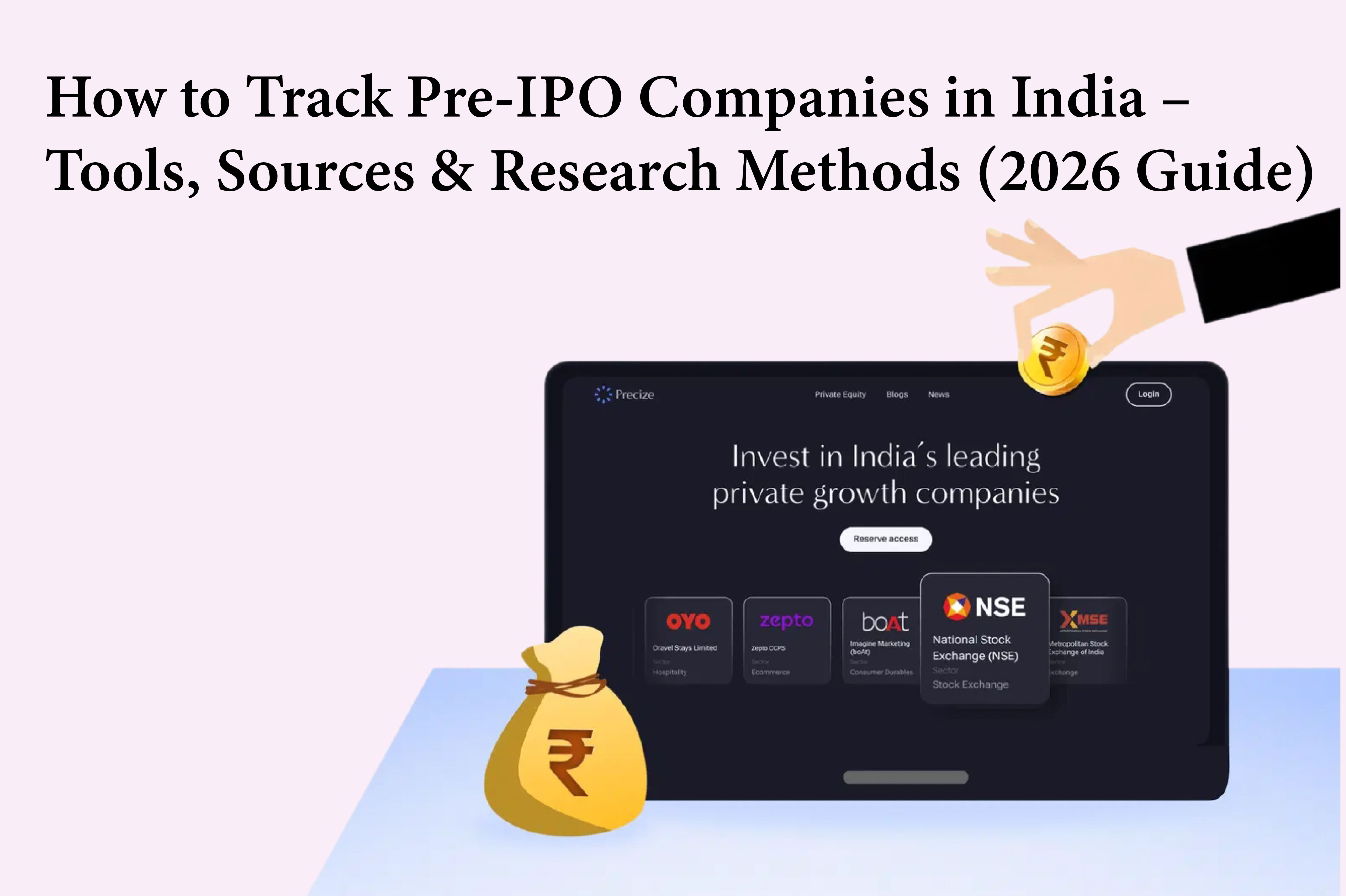
Tracking track pre ipo companies india refers to the process of identifying, monitoring, and analysing private companies that may go public in the future. Since these companies are not listed on stock exchanges, investors must rely on alternative data sources, filings, funding activity, and industry signals. Using structured pre ipo research tools, investors can track company progress, funding rounds, financial performance, and IPO readiness. A disciplined tracking approach helps investors identify opportunities early and evaluate them before they become widely available in public markets.
Tracking pre IPO companies in India involves systematically following private companies that are:
Unlike listed companies, pre-IPO firms do not provide continuous public disclosures. Therefore, investors must depend on:
This makes tracking a research-driven process rather than a price-driven one.
Understanding how to track pre ipo companies india is essential for investors looking to participate early in high-growth opportunities.
1. Early Identification of Opportunities
Tracking helps investors discover companies before they become widely known.
2. Better Entry Timing
Monitoring company progress allows more informed entry decisions.
3. Improved Due Diligence
Continuous tracking provides deeper insights into business fundamentals.
4. Understanding Sector Trends
Tracking multiple companies reveals which industries are attracting capital.
5. Reduced Information Asymmetry
Structured research reduces reliance on incomplete or speculative information.
Investor insight:
In private markets, information advantage often comes from consistent tracking rather than last-minute research.
Key Sources to Track Pre IPO Companies India
1. MCA (Ministry of Corporate Affairs) Filings
These filings provide official and verified company data.
2. SEBI Filings and DRHP
DRHP is one of the most reliable indicators of IPO readiness.
3. Startup and Funding Databases
These platforms track venture capital and private equity activity.
4. Financial News Platforms
News helps identify emerging trends and company movements.
5. Company Websites and Press Releases
Direct company communication offers useful insights.
6. Industry Reports and Research Publications
These reports help contextualize company growth.
7. Investment Platforms and Broker Networks
These sources provide practical exposure to private markets.
Using the right pre ipo research tools helps structure the tracking process.
1. Financial Data Platforms
2. Deal and Funding Trackers
3. IPO Tracking Platforms
4. Social and Professional Networks
5. Alternative Data Tools
These indicators provide early signals of business growth.
A structured approach ensures consistent and effective tracking.
Step 1: Identify Potential Companies
Step 2: Monitor Financial Performance
Step 3: Track Funding Activity
Step 4: Analyse Management and Governance
Step 5: Watch for IPO Signals
Step 6: Evaluate Market Position
Step 7: Maintain a Tracking System
| Factor | What to Check | Good Sign | Red Flag |
| Financials | Revenue & margins | Consistent growth | Declining performance |
| Funding | Investor participation | Reputed investors | Weak backing |
| Management | Experience | Strong leadership | Frequent changes |
| Market Position | Competitive strength | Clear advantage | Weak positioning |
| IPO Signals | DRHP, advisors | Active preparation | No clarity |
| Governance | Transparency | Structured reporting | Limited disclosures |
| Sector Trends | Industry growth | Expanding | Declining |
| Valuation | Funding benchmarks | Justified | Overvaluation |
| Aspect | Pre IPO Companies | Listed Companies |
| Data Availability | Limited | High |
| Price Discovery | Negotiated | Market-driven |
| Liquidity | Low | High |
| Research Effort | High | Moderate |
| Transparency | Variable | Standardized |
Key takeaway:
Tracking pre-IPO companies requires deeper research due to limited public data.
Focus on Companies If:
Avoid Tracking If:
Diversify Tracking
Key Insight
Tracking should be:
Investors should build a system rather than rely on isolated information.
1. Relying Only on News
News is useful but not sufficient for analysis.
2. Ignoring Financial Data
Tracking without financial analysis is incomplete.
3. Following Market Hype
Popularity does not indicate quality.
4. Not Maintaining Records
Lack of structured tracking reduces effectiveness.
5. Overlooking Governance
Weak governance can increase risk.
6. Tracking Too Late
Late tracking reduces early opportunity advantage.
Supremus Angel enables investors to access structured information on pre-IPO and unlisted share opportunities in India.
The platform focuses on:
This helps investors simplify the tracking process and make more informed decisions in private markets.
1. How to track pre IPO companies India effectively?
By using financial filings, funding data, news sources, and structured research tools.
2. What are the best pre IPO research tools?
Financial platforms, funding trackers, IPO tracking tools, and industry reports.
3. Is it difficult to track pre IPO companies?
It requires more effort than tracking listed companies due to limited data availability.
4. Where can I find information about unlisted companies?
MCA filings, company websites, funding databases, and investment platforms.
5. What is the most reliable source for IPO readiness?
DRHP filings and SEBI disclosures.
6. Can retail investors track pre IPO companies?
Yes, with the help of structured research tools and platforms.
7. How often should I track pre IPO companies?
Regular tracking (monthly or quarterly) is recommended.
8. What are early signs of IPO preparation?
Hiring investment bankers, DRHP filing, and increased disclosures.
9. Why is tracking important before investing?
It helps investors understand company growth and reduce uncertainty.
10. Can tracking guarantee successful investment?
No. Investment outcomes depend on company performance and market conditions.
Tracking track pre ipo companies india requires a structured and disciplined approach supported by reliable pre ipo research tools. Since private markets lack standardized disclosures, consistent monitoring becomes essential.
By combining multiple data sources, maintaining a tracking system, and evaluating companies systematically, investors can better understand opportunities before they enter public markets.
