
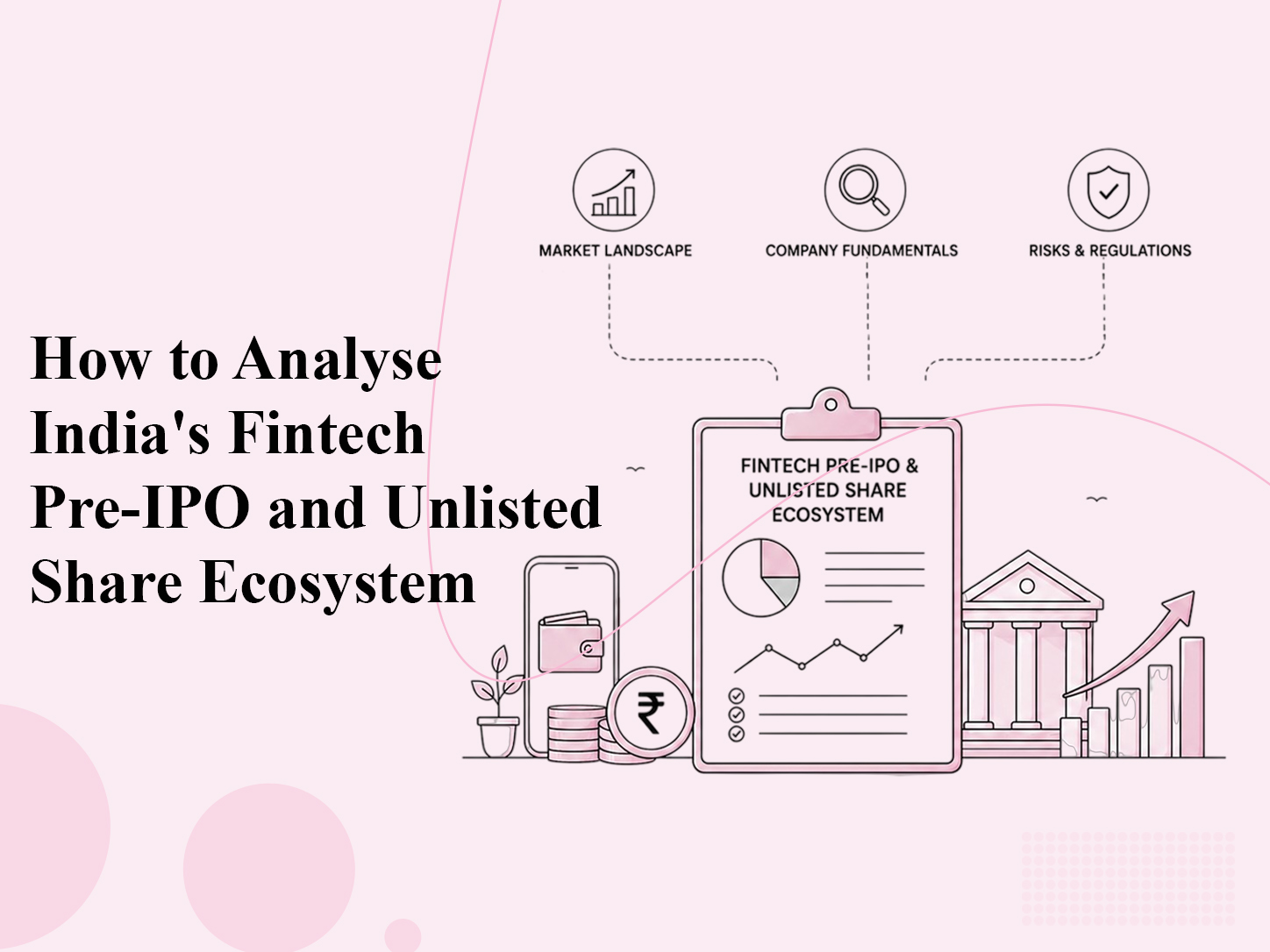
Fintech unlisted shares in India are equity stakes in payments, lending, wealthtech and insurtech companies that haven't listed on a stock exchange yet. If you're looking at unlisted fintech investments, the real work is understanding the revenue model, growth metrics, regulatory standing, cap table and valuation before any listing event ever happens. And because prices here come from private deals rather than continuous market trading, the whole approach to researching them looks different from picking a listed stock.
Fintech companies build technology-driven financial products across payments, lending, insurance, wealth management and banking infrastructure. Unlisted shares are simply equity in companies that haven't completed an IPO and don't trade on the NSE or BSE.
In practice, fintech unlisted shares in India are ownership stakes in these private businesses, usually picked up through employee stock option pools or secondary transactions. Pre-IPO fintech shares are a subset of these companies believed to be moving toward a listing though that belief doesn't guarantee anything. A company can stay unlisted for years with no near-term plan to go public at all.
Private-market transactions work differently from exchange trades in one key way: there's no central order book and no guaranteed counterparty. A buyer usually negotiates directly, or goes through an intermediary, at a price shaped by the company's last funding round. Liquidity here depends on finding a willing buyer rather than placing a sell order, which is exactly why holding periods tend to run longer and less predictably.
India's digital financial infrastructure spans UPI-based payments, digital lending, wealthtech, insurtech, financial SaaS, B2B fintech infrastructure and embedded finance. That created a large pool of private fintech companies at very different stages of maturity, some already profitable, many still burning cash to acquire customers.
This growth brings opportunity and risk together. Investing in unlisted fintech shares gets you access to companies years before a potential listing, but private companies disclose far less than listed ones, and a fast-growing sector doesn't automatically mean a fairly priced company. Sector tailwinds explain why capital keeps flowing into fintech; they don't explain whether any one company actually deserves its current valuation.
Start with how the company actually earns money transaction fees for payments, interest spreads for lenders, subscription fees for wealthtech. Recurring revenue tends to be more predictable than one-off transactional income. It's also worth checking customer concentration, since heavy reliance on two or three large clients adds risk that isn't always obvious from the headline numbers.
The right metric depends entirely on the business: transaction volume for payments, AUM and loan quality for lenders, active users for wealthtech. Revenue growth alone doesn't tell the full story; it needs margin and cash burn trends sitting right next to it before it means much.
Accounting profit, EBITDA, operating cash flow and free cash flow aren't interchangeable, and treating them as such is a common mistake. A fintech can show rising revenue while burning cash unsustainably in the background. How dependent a company is on fresh external funding often says more about its health than any single profitability number.
Fintech sits under closer regulatory scrutiny than most sectors, with oversight from the RBI, SEBI, IRDAI or PFRDA depending on the business line. A clean compliance history and correct licensing are baseline checks necessary, but not proof by themselves that an investment is safe.
Private-market valuation leans on price-to-sales, EV/Revenue and comparisons against listed peers. It helps to separate primary transactions from secondary ones early on. And the latest funding round price? That's a useful data point, not a verified fair value.
Review promoter ownership, institutional stakes, ESOP pool size, and whether preference shares exist. These details affect future dilution, and preference shares in particular can carry rights that change what common shareholders actually walk away with at exit.
IPO readiness isn't the same thing as an announcement. Scale, a credible path to profitability, governance and market conditions all shape whether a listing is actually feasible. Investors shouldn't assume any unlisted fintech will list on a predictable timeline or at all.
● Identify the business model each category runs on different economics
● Understand the revenue engine transactional, subscription, interest or commission-driven
● Examine financial performance across periods, not just one snapshot
● Assess unit economics acquisition cost versus lifetime value
● Evaluate regulatory exposure licenses and any history of enforcement action
● Analyse the cap table ownership concentration and ESOP size
● Compare valuation with listed peers, adjusted for growth and margin gaps
● Examine the latest private transaction price, and what actually shaped it
● Assess liquidity and exit considerations how the shares could realistically be sold
● Stress-test the thesis what has to be true, and what could go wrong
A red flag at any step is reason enough to dig deeper before taking a growth story at face value.
| Segment | Key Revenue Driver | Important Metrics | Major Risk |
| Payments | Transaction fees, float income | Volume, take rate | Thin margins |
| Digital Lending | Interest spread | AUM, NPA ratio | Credit risk |
| Wealthtech | Advisory/subscription fees | Assets under advisory | Market-linked swings |
| Insurtech | Commission on policies | Policies sold, renewals | Distribution dependency |
| Financial SaaS | Subscription fees | Client retention, ARR | Long sales cycles |
| B2B Fintech | Platform fees | Enterprise clients | Small client base |
| Embedded Finance | Revenue share with partners | Integrations, volume | Reliance on partners |
These segments monetise in fundamentally different ways, so using one valuation yardstick across all of them tends to mislead more than it clarifies.
| Factor | What to Check | Good Sign | Red Flag |
| Revenue growth | Multi-year trend | Consistent growth | Growth from one-off events |
| Revenue quality | Recurring vs transactional | Diversified streams | Reliance on few clients |
| Profitability | EBITDA, margin trend | Path to profitability | Widening losses |
| Cash flow | Operating, free cash flow | Reducing burn | Funding dependency |
| Unit economics | CAC versus LTV | LTV exceeds CAC | CAC rising faster |
| Customer concentration | Top-client revenue share | Broad base | Few clients dominate |
| Regulatory exposure | Licenses, compliance | Clean record | Past penalties |
| Governance | Board, audit practices | Independent audits | Weak disclosure |
| Shareholding | Cap table structure | Balanced ownership | Single-investor control |
| Dilution | Issuance history | Measured fundraising | Frequent dilutive rounds |
| Valuation | Multiples vs peers | Reasonable vs growth | Far above peers |
| Liquidity | Ease of future sale | Active secondary interest | Few past deals |
| IPO readiness | Scale, governance | Clear readiness | No credible path |
| Peer comparison | Model alignment | Comparable peers | Unrelated models |
A high headline valuation can mislead without context. Revenue multiples only mean something when read against growth rate and margin trajectory. Slow growth at a high multiple deserves far more scrutiny than fast growth at that same multiple. Listed peers offer a useful reference point, though private companies usually carry a discount for illiquidity, or occasionally a premium driven by scarcity and demand. The latest private or secondary-market price reflects sentiment at that particular moment, not a verified fair value. In other words, a high-growth fintech isn't automatically an attractively valued one.
● Treating sector-wide growth as proof of one company's quality
● Focusing only on revenue growth while ignoring margins
● Ignoring cash burn and funding dependency
● Assuming the last funding round price is the "correct" value
● Assuming an IPO is guaranteed for a large or well-funded company
● Overlooking regulatory risk specific to the license category
● Comparing fintech businesses that run on different revenue models
● Ignoring dilution from the ESOP pool and future funding rounds
● Underestimating just how illiquid unlisted shares can be
● Relying on rumours instead of verifiable financial information
There's no single checklist that settles this for everyone. Business quality, financial strength, valuation against peers, governance, regulatory exposure, and how liquid the holding actually is all of it carries weight, and how much depends on the investor. Time horizon matters too; unlisted positions often ask for years of patience before a credible exit shows up.
At the end of the day, the decision comes down to the company's fundamentals, its valuation, the risk profile, and the investor's own circumstances.
Unlisted shares are less liquid than listed ones; there's no continuous market, and no guarantee a buyer shows up the moment you want to sell. Transfer restrictions and clauses like right-of-first-refusal can tighten this further. Secondary-market transactions offer one route out, though pricing gets negotiated deal by deal. An IPO is one possible exit, not a guaranteed one; even strong companies push back listing timelines when market conditions turn against them.
Supremus Angel helps investors access information tied to pre-IPO and unlisted opportunities across sectors, fintech includes company details, share-related information, and market context that support an investor's own research. The idea is to make relevant information easier to find, not to push investors toward any particular outcome.
Supremus Angel doesn't promise returns, doesn't call any opportunity risk-free, and doesn't guarantee liquidity. Not every listing on the platform suits every investor deciding what fits remains the investor's call.
1.What are fintech unlisted shares in India?
Ownership stakes in privately held fintech companies payments, lending, wealthtech, insurtech that haven't gone public yet. Investors typically get access through ESOP pools or secondary deals on private-market platforms.
2.How can investors analyse fintech unlisted shares?
Start with the business model, then work outward: revenue quality, growth trends, profitability, regulatory exposure, the cap table, and how the valuation stacks up against comparable listed peers.
3.What is the difference between pre-IPO and unlisted fintech shares?
Unlisted is the broader bucket any private equity falls under. Pre-IPO fintech shares are a narrower group, referring to companies that seem to be heading toward a listing, though that's often perception more than a confirmed plan.
4.Are fintech unlisted shares available before an IPO?
Often, yes. Availability comes down to the individual company and whether current shareholders, usually employees or early investors are willing to sell.
5.How are unlisted fintech shares valued?
There's no ticker price to check. Valuation gets pieced together from the last funding round, recent secondary trades, and multiples borrowed from listed companies, adjusted for illiquidity.
6.What financial metrics matter most for fintech companies?
It depends on the business. Payments firms live by transaction volume; lenders track AUM and loan quality; wealthtech platforms watch active users. Margins and cash burn matter almost everywhere.
7.What regulatory risks should investors check in fintech companies?
Whether the company holds the right license from the RBI, SEBI, IRDAI or PFRDA, and whether it has a clean history with data protection rules and past penalties.
