
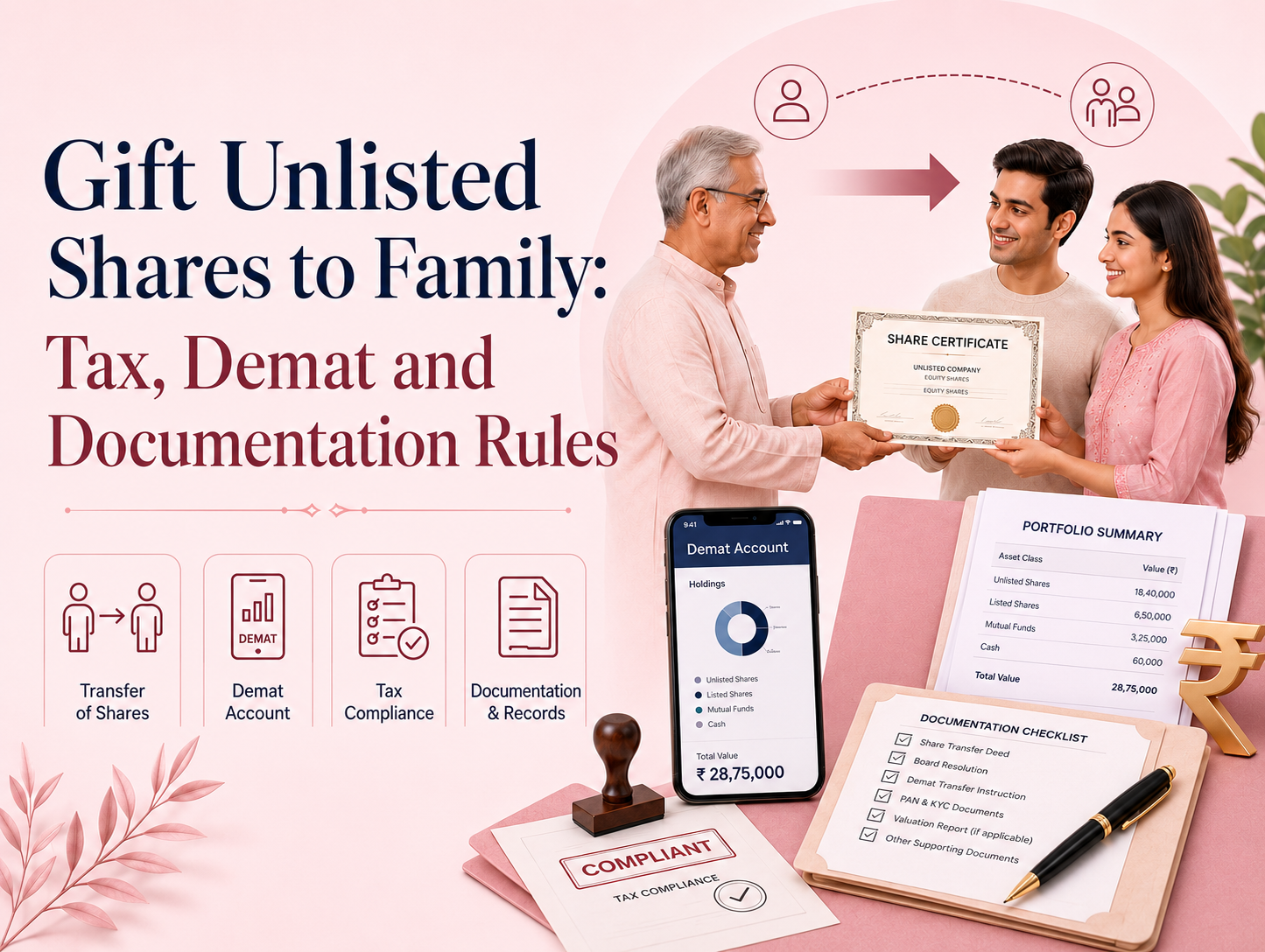
To gift unlisted shares to family means transferring ownership of privately held, pre-IPO or unlisted company shares to a family member without receiving money in return. In India, such transfers are possible, but they must be handled with proper tax understanding, demat instructions, company approvals and written records. A gift between specified relatives may not be taxable at the time of receipt, but investors still need to preserve cost, holding period, relationship proof and transfer documents for future tax and compliance purposes.
Gifting unlisted shares is different from selling them. In a sale, the shareholder receives consideration. In a gift, the transfer is voluntary and without consideration. The recipient becomes the owner after the shares are transferred in demat records or, in some cases, after the company updates its shareholder records.
Unlisted shares may include pre-IPO shares, private limited company shares, startup equity, family business shares, ESOP-converted shares or shares of a public company that is not listed on a stock exchange.
This type of transfer is common in family wealth planning. For example, a parent may transfer shares to an adult child, a husband may gift shares to his wife, or grandparents may transfer shares to grandchildren. The purpose may be succession, asset distribution or family ownership planning.
However, unlisted shares need more care than listed shares because pricing is not always visible. The company may also have restrictions on transfer. Private companies, by definition, have articles that restrict the right to transfer shares, so the Articles of Association and shareholder agreements should be checked before any transfer is initiated.
Gifting unlisted shares to family matters because the transfer may look simple within the family but can create long-term tax and documentation effects.
A family gift can affect:
The biggest mistake is assuming that a family transfer does not require records. Even if no tax is payable at the time of gift, the recipient may later need the donor’s original acquisition cost and purchase date. Without those records, calculating capital gains at the time of sale becomes difficult.
Unlisted shares also carry liquidity risk. A recipient may own the shares but may not be able to sell them quickly. The value of such shares depends on company performance, financials, governance, market demand and future exit opportunities. Investors should evaluate carefully before transferring high-value holdings.
The tax treatment depends mainly on the relationship between the donor and the recipient.
Under Section 56(2)(x), gifts received from specified relatives are generally not taxable in the hands of the recipient. The Income Tax Department lists relatives such as spouse, brother, sister, brother or sister of spouse, brother or sister of either parent, lineal ascendants and descendants, lineal ascendants and descendants of spouse, and spouse of such persons.
This means gifts between many close family members, such as father to daughter, son to mother, husband to wife or brother to sister, are usually covered under the relative exemption. In case of an HUF, any member of the HUF is treated as a relative for this provision.
If shares are gifted to a person who is not a specified relative, the tax position changes. Shares are treated as property for gift tax purposes. If the fair market value of such property exceeds the prescribed threshold, the value may become taxable as income from other sources in the recipient’s hands. The Income Tax Department explains that deemed income provisions can apply when property is received without consideration or for inadequate consideration.
The donor should also remember that a gift is not the same as a taxable sale, because there is no sale consideration. But the transfer should be genuine. If money is received separately or the transaction is structured as a gift only on paper, it may create tax risk.
The gift itself may not trigger tax between specified relatives, but capital gains can arise when the recipient sells the shares later.
For gifted assets, Section 49 provides that the cost of acquisition is generally taken as the cost for which the previous owner acquired the asset.
For example, suppose a father bought unlisted shares at Rs. 100 per share and later gifted them to his son. If the son sells the shares in the future, the father’s original cost may become relevant for capital gains calculation.
The recipient should preserve:
Clubbing rules should also be considered in specific family transfers. The Income Tax Department explains that income can be clubbed in certain cases involving spouse, minor child and other specified transfers.
A gift may be exempt at the time of transfer, but future income from those shares may still need review under clubbing provisions.
If unlisted shares are held in demat form, they are usually transferred through an off-market transfer.
NSDL explains that off-market trades are transactions not settled through the clearing corporation or clearing house of an exchange. Securities are moved from one demat account to another through delivery instructions.
CDSL’s Easiest facility also allows beneficial owners to submit off-market and inter-depository debit instructions from their demat account.
A demat gift transfer usually requires:
For unlisted shares, the process may not be as quick as a normal listed share transfer. The depository participant, company, registrar or internal compliance team may ask for additional documents. Investors should keep a time buffer instead of treating the transfer as instant.
Documentation is the most important part of a family transfer. A well-documented gift reduces future confusion and supports the tax position.
A proper gift file should include:
The gift deed should clearly state that the transfer is voluntary, without consideration and made out of natural love and affection. It should mention the company name, number of shares, ISIN, face value, donor details, recipient details and relationship.
For private company shares, also check the Articles of Association. Some companies require board approval before transfer. Some have right of first refusal clauses or shareholder agreement restrictions. Ignoring these conditions may delay or block the transfer.
Start by confirming whether the recipient is a specified relative under tax law. Do not assume every family member qualifies. Cousins, friends or distant relatives may not fall within the exempt category.
Next, check whether the shares are freely transferable. Review the Articles of Association, shareholder agreement, ESOP terms, lock-in conditions and any pre-IPO transfer restrictions.
Then prepare a gift deed. Keep the language clear and simple. It should show that no money is being paid by the recipient.
After that, check whether valuation is required. For gifts between specified relatives, valuation may not create immediate tax, but it is still useful for records. Rule 11UA deals with fair market value of quoted and unquoted shares and securities.
Once documents are ready, initiate the demat transfer through the DP, CDSL Easiest, NSDL process or physical DIS route, depending on the account setup. Enter the ISIN, quantity and recipient demat details carefully.
Finally, preserve all post-transfer records. The recipient should maintain the demat credit statement and donor’s original acquisition details for future sale or ITR reporting.
Before gifting unlisted shares to a family member, confirm that the recipient qualifies as a specified relative for tax purposes and that the shares are fully paid, transferable and free from lock-ins or unpaid liabilities. Review the company’s AOA and shareholder agreements for approval, ROFR or other transfer restrictions, and prepare a signed, dated gift deed. Keep fair market value support, verify the ISIN and beneficiary account details, and preserve the donor’s original cost and holding-period records for the recipient’s future tax reporting. Spouse and minor-child gifts should also be checked for clubbing provisions. Complete the required company, RTA or depository process, obtain confirmation, and ensure the transfer reflects genuine family or estate planning rather than appearing to be a tax-avoidance arrangement.
| Basis | Gift | Sale | Inheritance |
| Money received | No | Yes | No |
| Main purpose | Family transfer | Liquidity or exit | Succession after death |
| Tax at transfer | May be exempt between relatives | Capital gains may apply | Usually not taxed at inheritance stage |
| Key document | Gift deed | Sale agreement | Will or succession proof |
| Cost for future sale | Previous owner’s cost | Buyer’s purchase cost | Previous owner’s cost |
| Main risk | Weak documentation | Undervaluation or payment trail | Legal heir dispute |
Gifting unlisted shares to family may be suitable when the transfer has a genuine family purpose and all records can be maintained properly.
It may make sense when:
It may not be suitable when:
A gift should not be used as a shortcut to avoid proper tax planning. Investors should evaluate carefully and consult a tax professional where the value is significant.
Supremus Angel helps investors understand the practical side of pre-IPO and unlisted share transactions. For family transfers, the platform focuses on investor awareness, documentation clarity and process understanding.
Supremus Angel can help investors review important points such as company background, available share information, transfer process, demat requirements, indicative pricing, documentation needs and liquidity considerations.
The platform does not promise returns or present unlisted shares as risk-free. The value of unlisted shares depends on company performance, market demand, governance, regulatory developments and future exit opportunities. Investors should evaluate carefully before making any investment or family transfer decision.
1. Can I gift unlisted shares to family in India?
Yes, unlisted shares can be gifted to family members, subject to tax rules, demat procedures, company restrictions and documentation.
2. Is it taxable to gift unlisted shares to family?
If the recipient is a specified relative, the gift is generally not taxable in the recipient’s hands. Future sale may still attract capital gains.
3. Do I need a gift deed for unlisted shares?
Yes, a gift deed is strongly recommended because it proves that the transfer was voluntary and without consideration.
4. Can I gift pre-IPO shares to my son or daughter?
Yes, provided the shares are transferable and the company, DP or RTA accepts the required documents.
5. Can I gift unlisted shares to my wife?
Yes, a spouse is a specified relative, but future income may need review under clubbing provisions.
6. What is the cost of acquisition for gifted shares?
The recipient generally takes the previous owner’s cost for future capital gains calculation.
7. Can unlisted shares be transferred through demat?
Yes, if held in demat form, they can usually be transferred through an off-market demat transfer.
8. Is valuation required for gifting unlisted shares?
Valuation may not create immediate tax between specified relatives, but it is useful for records and future review.
9. Can I gift shares to a minor child?
Yes, but income from assets held by a minor may be clubbed with the parent’s income in certain cases.
