
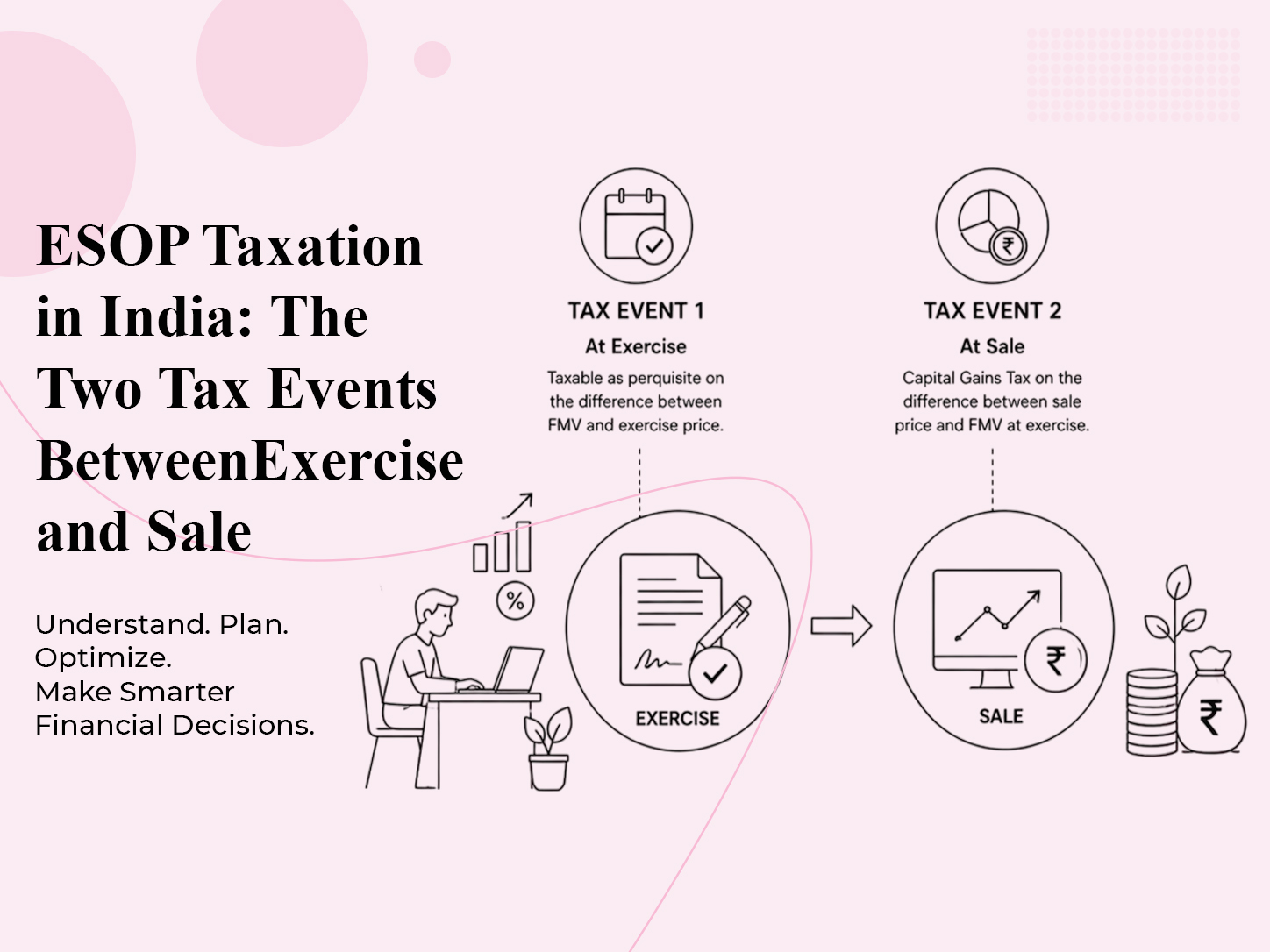
ESOP taxation in India applies at two separate stages: first as a perquisite (salary) tax when employee stock options are exercised, and second as a capital gains tax when the resulting shares are eventually sold. This two-event structure means an employee can owe tax on paper gains before receiving any cash, and again on the real gain when shares are finally sold. Understanding both events, and the gap between them, is essential for any employee or investor dealing with startup equity.
Employee Stock Ownership Plans (ESOPs) give employees the right to buy company shares at a pre-decided price, known as the strike or exercise price, after a vesting period. In India, this right does not create a tax liability by itself. Tax events under ESOP taxation in India are triggered only at two specific points:
No tax arises at the grant stage or during vesting. This is a common point of confusion, since many employees assume vesting itself creates a tax event, similar to how RSUs are treated. For ESOPs specifically, vesting is not a taxable milestone; only exercise and sale are.
The two-stage structure of ESOP taxation in India has direct financial consequences that go beyond simple tax planning.
When an employee exercises vested options, the difference between the FMV on the exercise date and the strike price is treated as a perquisite and added to the employee's salary income for that financial year.
Perquisite Value = (FMV on Exercise Date − Exercise Price) × Number of Shares Exercised
This amount is taxed at the employee's applicable income tax slab rate, and the employer is required to deduct TDS on it, similar to regular salary TDS. For listed companies, FMV is typically based on the average of the opening and closing market price on the exercise date. For unlisted companies, FMV must be certified by a registered merchant banker, and this valuation becomes the reference point for tax purposes.
When the employee eventually sells the shares, capital gains tax applies on the difference between the sale price and the FMV that was already used at exercise.
Capital Gain = Sale Price − FMV on Exercise Date (Cost of Acquisition)
The original strike price is not used again at this stage, since it was already factored into the perquisite calculation. This cost basis rule prevents the same rupee of gain from being taxed twice.
The rate and classification of this capital gain depend on the holding period, measured from the exercise date, not the grant date:
For employees of eligible DPIIT-recognised startups holding a valid certificate, the law permits deferral of the perquisite tax liability for up to 48 months from the end of the assessment year of exercise, or until the shares are sold or the employee leaves the company, whichever occurs first. This provision does not eliminate the tax; it only postpones the payment obligation, and eligibility is limited to a specific subset of recognised startups.
Employees and investors evaluating an ESOP situation should work through the following sequence before making exercise or sale decisions.
| Factor | What to Check | Good Sign | Red Flag |
| FMV certification (unlisted) | Valid Category I Merchant Banker certificate | Recent, independent valuation | Outdated or informal valuation |
| Exercise timing | Whether cash is available to cover perquisite tax | Sufficient liquidity planned in advance | Exercising without a funding plan |
| Holding period tracking | Date of exercise recorded accurately | Clear documentation of exercise date | No record of exercise date, risking wrong tax treatment |
| Startup deferral eligibility | DPIIT recognition and Section 80-IAC certificate status | Employer holds valid certificate | Employer assumed eligible but certificate not confirmed |
| TDS compliance | Employer has deducted and reflected TDS in Form 16 | TDS matches perquisite calculation | Mismatch between Form 16 and actual perquisite value |
| Cost basis for capital gains | FMV at exercise used as cost of acquisition | Consistent figures across Form 16 and ITR | Using strike price instead of FMV, leading to incorrect filing |
| ITR filing | Correct form used (ITR-2 or ITR-3, not ITR-1) | Both salary and capital gains components disclosed | Filing ITR-1 or omitting capital gains schedule |
| Aspect | Listed Company Shares | Unlisted Company Shares |
| FMV determination | Average of opening and closing market price on exercise date | Merchant banker valuation certificate required |
| Long-term holding threshold | 12 months from exercise date | 24 months from exercise date |
| Liquidity to sell shares | Generally available through the stock exchange | Depends on secondary transactions, buybacks, or IPO events |
| Valuation stability | Market-driven, updated continuously | Point-in-time estimate, may not reflect near-term market movement |
| Typical investor relevance | Straightforward pricing reference | Requires closer diligence on valuation basis and transaction structure |
There is no universal answer to when an employee should exercise ESOPs, since the right choice depends on company performance, valuation trajectory, and personal liquidity. A few structural considerations can guide the decision:
Investors evaluating pre-IPO or unlisted shares originating from ESOP exercises should treat the seller's cost basis and holding period as relevant diligence points, since they affect the seller's net proceeds and, indirectly, the terms of the transaction. Investment decisions should be evaluated on company fundamentals, valuation, and personal financial goals rather than on tax treatment alone.
Supremus Angel operates as a platform for pre-IPO and unlisted share transactions, where a meaningful share of available inventory originates from ESOP-holding employees at startups and growth-stage companies. Understanding the tax structure behind these shares, including how the seller's cost basis was established and what holding period applies, is a relevant part of evaluating any secondary transaction.
Supremus Angel provides investors with access to information and documentation related to unlisted share opportunities, and supports transaction structuring and diligence processes. The platform does not provide tax or investment advice, and outcomes from any unlisted share investment depend on company performance, market conditions, and the specific terms of each transaction. Investors are encouraged to evaluate each opportunity independently and consult a qualified tax professional or financial advisor for guidance specific to their situation.
ESOP taxation in India follows a clear two-stage structure: a perquisite tax at exercise, based on FMV, and a capital gains tax at sale, based on the appreciation since exercise. The gap between these two events, in both timing and cash flow, is where most planning challenges arise. Employees and investors dealing with ESOP-linked shares benefit from tracking exercise dates, FMV certificates, and holding periods carefully, since these details directly determine tax outcomes. As with any investment involving unlisted or pre-IPO shares, outcomes depend on company performance, and investors should evaluate each opportunity carefully rather than relying on tax structure alone.
1. Is ESOP taxable in India even if I don't sell the shares?
Yes. The perquisite tax is triggered at exercise, based on the FMV at that time, regardless of whether the shares are later sold.
2. What is the perquisite value in ESOP taxation?
It is the difference between the Fair Market Value on the exercise date and the exercise (strike) price, multiplied by the number of shares exercised. This value is taxed as salary income.
3. How is FMV determined for unlisted company ESOPs?
FMV for unlisted shares is determined using the prescribed valuation mechanism under the applicable Income Tax Rules, including the required merchant banker valuation.
4. What is the holding period for long-term capital gains on ESOP shares?
For listed shares, the holding period is 12 months from the exercise date. For unlisted shares, it is 24 months from the exercise date. The clock starts at exercise, not at grant.
5. Does the strike price matter when calculating capital gains at sale?
No. Once the perquisite tax has been paid at exercise, the FMV on the exercise date becomes the cost of acquisition for capital gains purposes. The original strike price is not used again.
6. What is the startup deferral for ESOP tax in India?
Employees of eligible DPIIT-recognised startups holding a valid certificate can defer payment of the perquisite tax for up to 48 months from the end of the assessment year of exercise, or until sale or exit, whichever comes first. The tax liability itself is not eliminated, only deferred.
7. Which ITR form should be used to report ESOP income?
Taxpayers holding unlisted equity shares or having capital gains/other disqualifying conditions generally need to use an appropriate return such as ITR-2 or ITR-3, depending on their income profile.
8. Does the employer deduct TDS on ESOP perquisite tax?
Yes. The employer is required to deduct TDS on the perquisite value at the time of exercise, similar to regular salary TDS, and this is reflected in Form 16.
9. How does ESOP taxation differ between listed and unlisted companies?
The core two-stage structure is the same, but FMV determination differs: listed companies use market price on the exercise date, while unlisted companies require a merchant banker valuation. The long-term holding period threshold also differs, 12 months for listed and 24 months for unlisted shares.
10. Can I avoid the perquisite tax at exercise?
Generally no, since it is a statutory requirement tied to the exercise event. Eligible startup employees may be able to defer the payment timeline under specific provisions, but the liability itself remains.
