
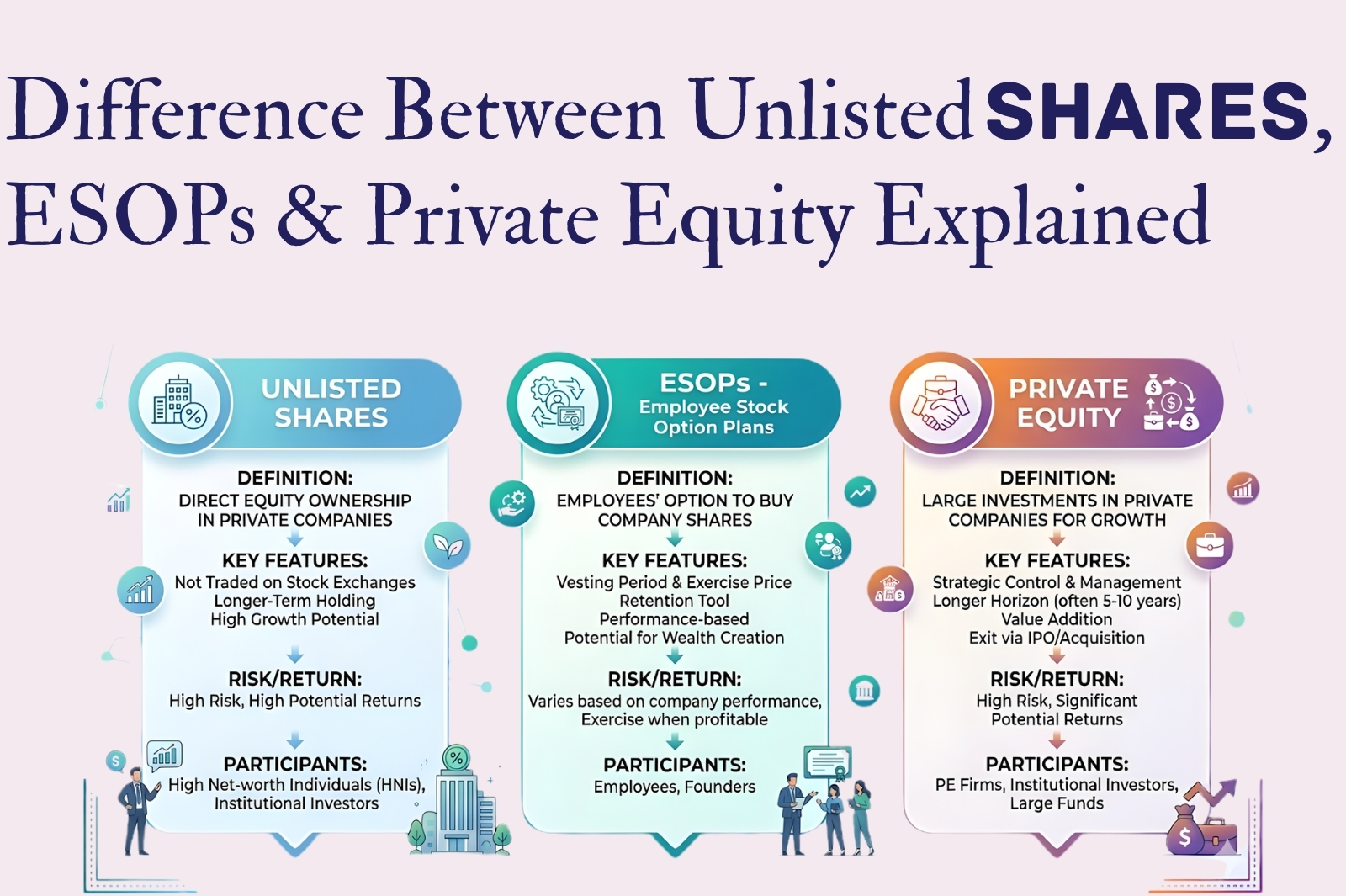
Many investors hear terms like unlisted shares, ESOPs, and private equity, but often assume they mean the same thing. In reality, these forms of equity represent very different ownership structures within private companies.
Understanding the difference between unlisted shares vs ESOPs vs private equity is important for investors, employees, and professionals who want clarity on how ownership works before companies enter public markets.
While unlisted shares are typically purchased by investors in private markets, ESOPs are granted to employees as part of compensation, and private equity investments are made by institutional funds seeking strategic stakes in businesses. Each of these equity structures plays a distinct role in how companies distribute ownership and raise capital before going public.
This article explains the key differences between these forms of equity and how they function within the private market ecosystem.
Unlisted shares are shares of companies that are not listed on public stock exchanges such as the NSE or BSE. These shares belong to private companies or companies that may be preparing for a future public listing.
Investors may purchase unlisted shares through private transactions. In many cases, these shares attract attention because they allow investors to gain exposure to companies before a potential IPO.
However, since they are not publicly traded, unlisted shares generally have lower liquidity compared to listed stocks.
Employee Stock Ownership Plans (ESOPs) are equity-based compensation programs offered by companies to their employees. Through ESOPs, employees receive the right to purchase company shares at a predetermined price after a specific vesting period.
Companies often use ESOPs to:
Once employees exercise their options, they become shareholders in the company.
Private equity refers to investments made by specialized investment firms or institutional investors into private companies. These investors typically provide large amounts of capital in exchange for equity ownership.
Private equity investments are usually aimed at:
Private equity investors often take an active role in business decisions and strategic planning.
| Aspect | Unlisted Shares | ESOPs | Private Equity |
| Definition | Shares of companies not listed on stock exchanges | Stock options given to employees as part of compensation | Investments made by institutional funds in private companies |
| Who Holds Them | Individual investors and institutions | Company employees | Private equity firms and institutional investors |
| Purpose | Investment opportunity in private companies | Employee incentive and retention | Strategic business investment |
| Ownership Structure | Direct share ownership | Right to purchase shares after vesting | Large equity stake with strategic involvement |
| Investment Size | Usually smaller individual investments | Depends on employee compensation structure | Typically large investments |
This comparison helps clarify the difference between unlisted shares vs ESOP and unlisted shares vs private equity.
Unlisted shares have certain features that distinguish them from other equity forms.
Early Access to Companies
Investors may gain exposure to businesses before they enter public markets.
Limited Liquidity
Since these shares are not traded on stock exchanges, buying and selling may take longer.
Potential Pre-IPO Opportunities
Many investors explore unlisted shares to participate in companies that may eventually go public.
ESOPs are not typically designed as investment opportunities for external investors. Instead, they function as an internal incentive mechanism.
Important aspects of ESOPs include:
Vesting Period
Employees must remain with the company for a defined period before they can exercise their options.
Exercise Price
Employees purchase shares at a predetermined price set when the options are granted.
Employee Ownership
Once exercised, employees become shareholders in the company.
Private equity plays a significant role in funding business expansion and operational improvements.
Private equity firms typically:
These investments often occur during later stages of company growth.
What are unlisted shares?
Unlisted shares are shares of companies that are not traded on public stock exchanges. They are typically held by founders, early investors, and private market participants.
What is the difference between unlisted shares and ESOPs?
Unlisted shares represent direct ownership in a company, whereas ESOPs are stock options given to employees that allow them to purchase shares after completing a vesting period.
How is private equity different from unlisted shares?
Private equity refers to investments made by institutional investors or funds in private companies, often involving large capital investments and strategic involvement in the business.
Can employees sell ESOP shares?
Employees may sell their shares after exercising their ESOPs, depending on company policies and available private market opportunities.
Are unlisted shares risky?
Like any private market investment, unlisted shares involve risks such as limited liquidity and valuation uncertainty.
Understanding how unlisted shares, ESOPs, and private equity differ helps investors and professionals better interpret ownership structures in private companies. Each of these mechanisms plays a different role in how businesses distribute equity and raise capital before entering public markets.
For individuals interested in exploring opportunities within the private market ecosystem, Platforms such as Supremus Angel focus on providing educational insights about the private market ecosystem and help investors understand opportunities related to unlisted shares and pre-IPO companies.
